The FBI's vaunted crime lab is a scandal of atrocious forensic science. Its "junk science" permeates the U.S. criminal justice system as it bogus "findings" routinely punish the innocent and set the guilty free, affecting thousands of lives in the process.
by John F. Kelly and Phillip K. Wearne
Scientific crime solving or sci-crime – it is an image upon which much of the FBI's awesome reputation is based. Humans are fallible, are inclined to lie and are often motivated by anything but the truth. The history of crime fighting in the United States is littered with eyewitnesses who misidentified a suspect, defense lawyers who persuaded juries to find reasonable doubt, and suspects who had credible alibis. The physical evidence on the other hand is the silent, definitive witness. The traces of explosives on Timothy McVeigh's clothes in Oklahoma City, the bloody shoe-prints left by the killer of Nicole Brown Simpson and Ron Goldman in Los Angeles, the saliva traces recovered from the sealed envelope of a letter claiming responsibility for the bombing of the World Trade Center…all these offer certainty. And certainty equals proof.
The means of making physical evidence proof is forensic science, the application of science to legal processes, the application of science to crime-fighting. Together or apart, the words "forensic" and "scientific" are today commonly used as everyday adjectives that imply definitive, detailed and comprehensively argued. It is an image burnished by popular television detective series like "Quincy" and the coverage of big cases by Court TV, an image epitomized by the source of the country's most famous forensic science, the FBI's crime lab.
Each year half a million people hear and see the case for forensic science when they take the public tour of the FBI headquarters in downtown Washington, D.C. The J. Edgar Hoover Building is a monstrous, sandy-brown structure that somehow exudes the brooding presence of the man whose name it bears. With an overhanging, slanting top floor -- the seventh at the front, the eleventh at the back – the FBI's HQ looks as though it might topple onto the traffic in Washington's Pennsylvania Avenue at any moment. Passing the black-and-white photographic portraits of FBI directors and the rogue's gallery of the "Ten Most Wanted Fugitives," a narrow escalator takes visitors to the only working part of the FBI they will see on their visit -- the laboratory. The sign that greets them proclaims: "61 years of Forensic Science Service, DNA: The Silent Witness." It's the sort of public relations exercise of which J. Edgar Hoover, the FBI's former director, the "The Boss" as he was known to agents for nearly 50 years, would wholeheartedly approve. To Hoover, image was everything, a legacy that thrives at the FBI to this day.
"The examiners you see are working on real cases," says the guide as children press their faces to the panes of glass that are all that separate the watchers from the watched. "The FBI is the only place in the United States with a full forensic lab," she adds, spinning through DNA, Firearms-Toolmarks, Hairs and Fibers, Material Analysis, Chemistry and Toxicology and Questioned Documents -- the visible components of the lab's seven-unit Scientific Analysis Section. Here the victims of serious crime -- rape, murder, violent assault -- are reduced to a piece of bloodstained clothing, a hair from the carpet, an invisible explosive residue on a nondescript piece of debris. Only if photos, tapes or handwritten notes come in as part of the evidence do such people have the faces, voices, or hands that make them real.
What the tourists see is actually just a fraction of what makes up the FBI's Laboratory Division. The Scientific Analysis Section is one of just five FBI lab sections with a bewildering range of state-of-the-art expertise, technology and capacity. Today's Investigative Operations and Support Section grew out of the Questioned Documents Unit, where examiners detect crime by chasing paper records. They look at everything from receipts to handwriting comparisons, targeting everyone from drug smugglers to kidnappers. Documents also handle all types of impressions -- tire treads, shoe prints, handwriting or typing imprints. Today, this section includes the specialist polygraph or "lie detector" unit, a computer analysis unit, a special photographic unit and specialists in analyzing racketeering records -- illegal gambling, prostitution, loan-sharking, and money-laundering.
The Special Projects Section is even more diverse, with seven units that handle film, video and photographs of suspects or victims; the famous artists "impressions" of witnesses' descriptions of suspects; crime-scene plans; and now computer art and design. The aging or reconstruction of faces of suspects or victims and the reconstruction of crime scenes is a specialty. This section also prepares all forms of graphics or film used as exhibits at trial and the false credentials or documentation needed by FBI agents or informants for undercover work. Here too is the Evidence Control Center, responsible for the receipt, assignment, and tracking of thousands of lab samples subjected to hundreds of thousands of examinations every year.
Finally, practicing one of the oldest and best-known disciplines of forensic science, there is the FBI lab's Latent Fingerprint Section. Here the main task is developing and comparing fingerprints, palm prints, footprints and even lip prints with some of the estimated 200-million imprint records stored at the FBI's National Crime Information Center in West Virginia. Under an automated fingerprint-identification system now being developed, law enforcement officials anywhere in the country will soon be able to match instantly sample prints with those in the database by means of portable computer images.
Much of the work in all lab departments is clinical, routine, tedious, even though the samples, which can range from soil to bullet casings, are often anything but. Yet this is by far the nation's biggest, most important, best-equipped and most famous crime lab. As an examiner here, you never know what you are going to get -- it could be a rape one day, an explosion the next, and a product- tampering case the day after that. "Here you might start work on the case of a lifetime any day, anytime," says one employee. And it could come from anywhere. As well as its own cases -- federal crime or crime that involves more than one state -- the FBI lab takes work from state, county and municipal law enforcement agencies across the nation. As a result, its 694 staff handled 136,629 pieces of evidence and performed nearly 700,000 examinations in 1996.
In the past 25 years forensic science has been transformed, "growing up so fast that even the most sophisticated researchers cannot keep up," according to Time magazine. Nowhere more so than in the heart of the FBI lab, the Scientific Analysis Section. Here, the traditional scientific paraphernalia -- the test tubes, gas tanks, and microscopes that recall school chemistry classes -- rub shoulders with infrared spectroscopes, Apple and Dell computers and neutron activators. Forensic science is now genetics and microbiology in DNA typing, nuclear physics in neutron activation analysis, analytical chemistry in infrared, ultra-violet or X-ray spectrometry and statistics in computerized number crunching.
These new technologies have in many cases been grafted onto a profession that in many of its traditional sub-fields, like fingerprints, questioned documents, ballistics, hair and fibers, explosives, was not actually based on science at all but on subjective comparisons by individual examiners. Yet either way, whether the "soft" science of the traditional visual comparisons of two hairs, bullets or fingerprints, or the "hard" science of neutron activation analysis or DNA typing, forensic science cannot ultimately avoid the human factor. The examiners who do the tests, run the machines and make the comparisons are only human. At the FBI lab and the nearly 400 other crime labs in the United States, those people have turned out to be as flawed as the eye-witnesses, juries or lawyers who make up the rest of the judicial process.
But if scientific crime-fighting is fallible and flawed, those problems rarely come to light. One exception was in July 1994, when U.S. Today and the Gannett News Service published a survey. Believing that the claim that the bloody glove found on O. J. Simpson's estate had been planted was far-fetched, the newspaper trawled legal and media databases for comparative cases. They found 85 instances since 1974 in which prosecutors had knowingly or unknowingly used tainted evidence that had convicted the innocent or freed the guilty. In the same period, 48 people sentenced to death were freed after convictions were found to be based on fabricated evidence or because exonerating or exculpatory evidence was withheld.
These were just the known cases, cases that for one reason or another had come to light or made the news. "In the United States we take science as gospel," said Ray Taylor, a San Antonio-based lawyer and forensic pathology expert, commenting on the survey. "The public perception is that faking science is rare. The truth is it happens all the time."
The tip of this iceberg has been some shocking individual examples. Fred Salem Zain was a police forensic expert in West Virginia and Texas for nearly 15 years. Hired as a chemist by West Virginia State police crime lab in 1979, he testified as an expert in dozens of rape and murder cases about tests he had never done and results he had never obtained. Despite complaints, nothing was done. Colleagues taped a magician's wand to one of Zain's laboratory machines in frustration. In 1989, Zain became head of serology at the Bexar County Medical Examiner's office in San Antonio. When asked to review Zain's work, the Dallas forensic specialist I. C. Stone found rampant fraud and falsification. In one case, Zain had testified about blood evidence when no blood had been found; in other cases he reported performing tests his lab was incapable of doing. Zain was fired. At the last count, five men jailed for rape and murder have had their convictions overturned as a result.
West Texas pathologist Ralph R. Erdmann, who worked as a contract medical examiner in 40 counties, faked more than 100 autopsies on unexamined bodies, and falsified dozens of toxicology and blood reports. Dozens of other autopsies were botched. In one case he lost a head. Then there was Louise Robbins, a college anthropology professor who claimed the ability to match a footprint on any surface to the person who made it. Robbins appeared as an expert witness for over a decade in more than 20 criminal cases throughout North America before her claims were thoroughly debunked. Her testimony helped put more than a dozen people behind bars, including an Ohio man who spent six years on death row before his conviction was overturned on appeal.
Michael West was a forensic dentist from Hattiesburg, Miss., who appeared as a scientific expert more than 60 times in 10 states until 1996. At least 20 of these were capital murder cases. West became famous for his controversial use of long-wave, ultraviolet light and yellow-lensed goggles to study wound patterns on a body. The equipment is standard: Ultraviolet light can enhance features on the skin. What West claimed he could see was not standard: No other forensic expert could pick up the lines and marks he claimed to see. Robert Kirschner, a former deputy-chief medical examiner who testified against West, says what West did was closer to voodoo or alchemy than science. "History is full of people who claimed they could see things, from ghosts to UFOs," says Kirschner. "But claiming it and proving it are two different things."
The biggest and self-proclaimed best forensic lab in the world has not been immune to such rogues. In February 1975, an internal FBI investigation into the activities of Special Agent Thomas N. Curran, an examiner in the FBI lab's serology unit, revealed a staggering record of perjury, incompetence and falsification. At the trial of Thomas Doepel for rape and murder in Washington, D.C. in 1974, Curran testified under oath that he had a bachelor and masters degree in science, that both Doepel and the victim were blood type O and that the defendant's shorts bore a single bloodstain. In reality, Curran had no degree in anything; Doepel, on re-testing, turned out to be blood type B; and the shorts evidenced two, not one blood stain.
After further complaints, FBI Special Agent Jay Cochran was instructed to do a full review of Curran's work. Curran's aberrations, like Zain's, were systemic. Curran had issued reports of blood analyses when "no laboratory tests were done"; had relied on presumptive tests to draw up confirmatory results and written up inadequate and deceptive lab reports, ignoring or distorting tests results. "The real issue is that he chose to ignore the virtue of integrity and to lie when asked if specific tests were conducted," concluded Cochran's report to the then head of the FBI laboratory, Dr. Briggs White. It was an early warning of what could happen at the FBI lab. Tom Curran turned out to have lied repeatedly under oath about his credentials and his reports were persistently deceptive, yet no one, FBI lab management, defense lawyers, judges, had noticed. When they did, there was no prosecution for perjury.
Of course, every profession has its rotten apples. Forensic science is no different from the law, medicine, academia, law enforcement or anything else. The issue is not the Zains or Currans per se, but the questions their conduct raises. How did they get into the profession? How did they get away with it so long? Why are they not stopped and punished? Why do juries, judges, prosecutors and even defense attorneys believe them?
Take a close look at forensic science and answers are not hard to come by. The first shock is that most forensic scientists are not in fact independent experts. About 80 per cent of forensic scientists in North America are affiliated with police or prosecution agencies. Most of these work in police laboratories; many are themselves law enforcement officers, as are most of their superiors. Fred Zain was a state trooper, promoted to lieutenant; Tom Curran was an FBI Special Agent. The potential conflict of loyalties and interests is obvious. Scientists are expected to retain a critical sense, to follow nothing but reason, to maintain an open mind. We expect the results, the science, to bear witness in court unencumbered by any other considerations. Complete impartiality may be an aspirational ideal but what chance is there of coming anywhere near this ideal if the police or FBI pay your wages?
"It is quite common to find laboratory facilities and personnel who are, for all intents and purposes, an arm of the prosecution," notes James Starrs, a professor of law and forensic science at George Washington University in Washington, D.C. "They analyze material submitted, on all but rare occasions, solely by the prosecution. They testify almost exclusively on behalf of the prosecution...As a result, their impartiality is replaced by a viewpoint colored brightly with prosecutorial bias." William Thompson, a professor of criminalistics at the University of Irvine in California agrees. "The culture of such places, run by police or agents, for police or agents is often just inimical to good scientific practice. The reward system, promotion, incentives…in the end your pay check is based on successful prosecutions, not good science."
Nowhere is this truer than at the FBI laboratory in Washington, the pinnacle of the forensic science mountain in the United States. Institutional bias here is enshrined in the limitation of the availability of the lab and its services to state and federal law enforcement agencies. The FBI lab works for the prosecution and no one else. It is reinforced by the FBI lab's reluctance to give or take second opinions. Generally, evidence submitted to the FBI laboratory may not be taken elsewhere or vice versa, even though that might be considered the peer-review deemed essential by scientists. The FBI lab is happy to clear suspects and frequently does. However, defense teams need to get a court order and be prepared to share any findings with the prosecution if they want to use the government-funded facility. Indeed, the lab is even off-limits to defense experts who want to observe testing.
The prosecutorial attitude was made clear by one lab veteran now working privately. "People say we're tainted for the prosecution. Hell, that's what we do! We get our evidence and present it for the prosecution." In the FBI laboratory, "getting results," the declared aim of FBI Director Louie Freeh, means securing prosecutions. But that is only part of the story. Those on the public tour staring through the viewing windows of the Scientific Analysis Section of the FBI laboratory might be surprised to learn that many of the white-coated figures hunched over microscopes or spectrometers are FBI agents. Some have science degrees, but many, particularly, ironically, those in the most senior positions do not. They are FBI men and women working for an FBI laboratory.
For more than 20 years, the FBI resisted replacing its special agents who work in the laboratory with civilian scientists. Even now, after several years of replacing agents with such personnel, FBI agents continue to run the lab, occupying virtually all the senior-management and examiner positions. FBI special agents bring an "extra dimension" to the analysis of physical evidence, the FBI insists. The ideal lab specialist "stands in the shoes of the investigator in the field, whom he is serving," as John McDermott, a senior FBI official, put it to a Congressional subcommittee in 1981.
Serving the investigator or serving justice? Close liaison between examining agent and investigator, the core of the FBI's argument, can easily create bias that is often so subtle as to be unconscious. In the first place, there is simply the method of working. "Sometimes they're [investigators] pretty confused about what they want, so we'll call them up to find out what they're trying to prove," the then FBI Firearms-Toolmark Unit chief Jack Dillon told us. "Often we can suggest some better ways of doing it."
By "doing it" of course Dillon means trying to prove guilt. "That is what I have come to call putting the cart before the horsing around," says Professor Starrs. "They're effectively running the investigation backwards, starting with a hypothesis of guilt then going out to try and prove it. That is not science. These people aren't scientists."
Secondly, there is suggestive incrimination. Numerous studies have shown that advance warning of the results anticipated, even something as simple as looking for a match or positive identification, is significantly more likely to produce those results. In just one example, experiments in 1975 demonstrated that a witness told by police that a suspect was in an identification line-up was seven times more likely to pick out a suspect than those advised only that a suspect might be present. Expectations can be unconsciously passed on, verbally and non-verbally.
One good example of suggestive incrimination comes from Evan Hodge, a former Firearms-Toolmarks Unit chief at the FBI laboratory. In an article entitled "Guarding Against Error" he tells the story of a police inspector who took a 1911A1-model .45- caliber pistol to a lab for confirmation that it was a murder weapon. "We know this guy shot the victim and this is the gun he used," the examiner was told. "All we want you to do is confirm what we already know so we can get the scumbag off the street. We will wait. How quick can you do it?" The examiner gave them their instant identification. The suspect confessed and led the police to a second pistol, also a .45, also a 1911A1 model, which lab tests demonstrated was the real murder weapon. "We all do this (give in to investigative pressure) to one extent or another," Evan Hodge admits, arguing that the only solution is to remove the sources of it from the laboratory completely.
Investigators in the field, and the close contact the FBI lab advocates with them, are one source of pressure. There are many more. Prosecutors are one. Politicians, another. The public, yet another. Few criminal cases today do not lean on forensic science, and as the search for the means to combat crime has intensified, so have the expectations. At the FBI, major cases like TRADBOM (the bomb attack on the World Trade Center in New York) and OKBOM (the Oklahoma City bombing), get the sort of priority, as well as public and political attention that is, in itself, a source of pressure. These cases are too big to leave unsolved in the lab, too big to lose in court. The government will throw infinite investigative and legal resources at them. Lower down the crime lab chain, the stakes may be just as big locally. Careers may depend on results. "Don't expect to get re-elected as a district attorney in this country if a particularly heinous crime goes unsolved on your patch," notes one Southern lawyer.
Former FBI supervisor special agent Dr. Frederic Whitehurst turned whistleblower from such pressures, in particular the culture clash between the needs of science and the needs of law enforcement that are accentuated by the dominance of a law enforcement ethos rather than that of science in the FBI lab. Many accused him of being unable to make the distinction between pure and practical science. Yet Whitehurst is actually quick to acknowledge the uniqueness of the forensic process within science. The forensic scientist seeks to link a sample to an individual, to a substance, to distinguish it from other specimens in a way no other scientist would even attempt. The forensic scientist's standard fare is the sort of degraded, soiled sample that research scientists would trash if it ever came near their laboratory. The forensic scientist's goal is not pure knowledge but practical supposition.
Whitehurst's contention was simply that such ends had to be underpinned by scientific method, proven protocols and validated procedures or they would yield no proven truth, the ultimate aim of both law and science. Forensic science had to use procedures and processes that had withstood traditional scientific scrutiny -- i.e., been subjected to publication and peer review, the sort of "institutional skepticism" that is the cornerstone of the scientific process. Forensic science examinations should be full-documented, subject to cross-examination and the results and process available to the defense. The reality is somewhat different. The openness, democratic debate, public dissemination, and protracted research that are the hallmarks of proper science contrast sharply with the secrecy, haste and authoritarian hierarchy of the crime lab.
For years, some lawyers and many scientists have argued that forensic science is hardly a branch of science at all in its refusal and institutional inability to accept or conform to scientific norms. With relatively little research done in forensic science itself, there has been a propensity to adopt or adapt half-baked research done elsewhere. The result: Time after time definitive research in the field of forensic science has only been done after questions have been raised about the accuracy and reliability of its procedures, usually in court. The FBI lab, with the biggest forensic science research facility in the country -- the Forensic Science Research and Training Center at Quantico, Va. -- has been at the center of many of the resulting disputes.
The forensic history of voiceprints -- the claim that a spectrograph could be used to produce a unique pattern for any single individual's speech -- is particularly instructive. With some research concluded, a number of courts ruled voiceprints admissible. Only when scientists from other fields challenged the spectrograph research and a major scientific controversy erupted did the FBI ask the National Academy of Sciences to review voiceprint technology. An NAS evaluation committee quickly concluded that the theory had not been validated. Yet, incredibly, many courts continued to allow the admissibility of voiceprints long after the NAS study had been published.
Those that present science to the public at public expense are surely obliged to understand its basic precepts. Yet many in the FBI lab do not. Court records throughout the country are littered with examples. In a recent aggravated-assault and burglary trial in Montana, FBI fingerprint expert Michael Wieners asserted that a fingerprint experiment he had done was "scientific" but not "completely scientific." It was not surprising he could not tell the difference. Challenged about his familiarity with peer-reviewed literature on fingerprints, Weiners replied: "Peer reviewed? Could you explain that?"
Complaints about such ignorance preceded Fred Whitehurst's arrival at the FBI lab in 1986. In 1981, three prominent independent forensic scientists criticized FBI science and testimony, citing three cases in a paper delivered at the Annual Meeting of the American Academy of Forensic Sciences in Los Angeles. The first was a bank-robbery case in which the FBI examiner seemed to have been unable to distinguish between a class characteristic and an individual characteristic in identifying a canvas bag, despite having a master's degree in forensic science. In the second case, a rape and murder with semen, blood, saliva and hair samples, the paper criticized the FBI's typing procedure. The critics also pointed out that two FBI hair examiners who had examined the same hair specimens had disagreed on such fundamentals as how many samples there were, whether they had been bleached, and whether they had pulled roots. The third case involved gun residue on a shooting victim's hands that could have exculpated his wife, the defendant, yet had not been mentioned by the FBI examiner.
The authors of the paper stressed that they did not consider these cases aberrations. These case studies were, they claimed, typical of the problems that occurred repeatedly in crime labs and courts. They noted that FBI lab practice was considered standard by many courts, but emphasized that they were not singling out the FBI laboratory. The FBI Bureau did not see it that way. Shortly after the presentation, a former head of the FBI lab, Thomas J. Kelleher Jr. charged that the authors, Peter Barnett, Ed Blake and Robert Ogle Jr., had violated the code of ethics of the AAFS in making the presentation. They had, Kelleher claimed, misrepresented the role of the lab and the conclusions of FBI examiners. Thus, the actual leveling of the charges, not the substance of the allegations themselves, became the subject of an investigation by the AFFS's ethics committee.
Ultimately it was decided that there was not "sufficient evidence of misrepresentation of data" by the authors to support the FBI's allegation. "The FBI's allegations were preposterous, I think we made them look ridiculous," says Ed Blake, now a long-time critic of the FBI's forensic science. "We chose the FBI lab to show that crime labs could get it wrong because we thought they were big enough to take a little criticism," chuckles Robert Ogle Jr. "Fortunately there was someone with a scientific background on the ethics committee. They just said: "Look this is bullshit. You can't bring ethics charges against people for giving a scientific paper at a scientific meeting."
Years later, Whitehurst's charges and his treatment would mirror those of these three, whose observations, along with Whitehurst's, would be vindicated by the U.S. inspector general's report. As the three critics pointed out in a letter to Professor Starrs's quarterly newsletter, Scientific Sleuthing Review, their paper cited "errors or insufficiencies on the part of the original examiner…management deficiency…[and] a lack of knowledge." The IG report, 16 years later, cited "failures by management" and "significant instances of testimonial errors, substandard analytical work and deficient practices." The damage done to confidence in crime labs in general and the FBI lab in particular might have been avoided if the substance of their charges -- not the fact that they had been made -- had been addressed back in 1981, the three pointed out. But the FBI lab seemed incapable of addressing these issues or indeed of changing anything about the way it operated. Indeed, the very manner in which the FBI handled Whitehurst's complaints -- dismissing them, burying them, then attacking the messenger rather than the message -- illustrated how little the culture of the FBI lab had changed since 1981.
At the core of what the critical experts were alleging is the poor practice that riddles the FBI lab and much forensic science in the United States. Documentation is a case in point. Examiners have proved remarkably loath to write up their bench notes in any adequate scientific manner. No names, no chain of custody history, no testing chronology, no details of supervisory oversight, no confirmatory tests, no signatures -- such omissions are quite normal in FBI lab reports. What they do contain is obfuscation and overstated conclusions written in an often-incomprehensible style that some experts have termed "forensonics." Terms like "match" or "consistent with" are common; chronicled scientific procedures and protocols to justify them are not.
The motive seems to be to say as little as possible as unintelligibly as possible with what passes for scientific jargon and process. Our numerous conversations with former FBI lab personnel and attorneys have left no doubt why. Since lab reports are discoverable and have to be provided to the defense, the FBI lab believes that as little as possible should be given away. The approach to research is no different. The publication of findings or methodologies might be used to undermine the prosecution of cases, so no dissemination has been the rule. In short, the FBI's interpretation of the adversarial approach on which the U.S. judicial system is based, works to serve neither science nor truth.
As such, the FBI lab's reports have shocked those outside the U.S. forensic science community. "If these are the ones (reports) to be presented to court as evidence then I am appalled by the structure and information content.…[T]he structure of the reports seems to be designed to confuse," concluded Professor Brian Caddy, head of the forensic science unit at Strathclyde University in Scotland on being shown the FBI lab's forensic reports in the Oklahoma City bombing case.
Much the same goes for protocols or established procedures. Traditionally, many FBI forensic scientists have not used protocols – the recipes for analyses and the touchstones of scientific procedure -- despite the fact that all scientists accept that not using them produces only experimental, not proven outcomes. Indeed, in some crime labs, established protocols do not even exist. "Basically what we've got is a kind of oral tradition, like medieval English, the Venerable Bede, instead of a regular scientific protocol manual," claims Steven Jones, Timothy McVeigh's first defense lawyer in the Oklahoma City bombing case, who has looked into FBI lab procedures in some depth. "The advantage of the oral tradition of course is that no one knows what it is."
Such shortcomings are often accentuated in court. Here pressure from prosecutors is direct. All too often the important caveats that punctuate forensic science, phrases such as "including but not excluding," "possible but not certain," "compatible with but not incompatible with" are forgotten. All too often "could" becomes "did", an opinion becomes a fact, tests that only suggest are said to "prove." Even if the forensic scientist is sufficiently guarded, prosecutors or even judges are often less so.
"The expert may say something quite guarded like 'was similar' and within minutes you'll hear the prosecutor reinterpret that as a definitive identification," complains Professor Starrs. "How many times do you hear the word 'match'. What the hell does it mean? It must be the most overused word in forensic science." Indeed, surveys have demonstrated that there is no agreement on the definition of such key terms among forensic experts themselves.
In the cauldron of the courtroom, testifying beyond one's expertise becomes commonplace, especially under the FBI's system where auxiliary examiners, often civilian scientists, actually do the tests, but principal examiners, invariably FBI agents, have tended to do the testifying. All too often the fingerprint expert is invited to comment or even speculate on the bloodstains, the firearms expert on the nature of the bomb explosive, the documents examiner on the toolmarks. When only one expert is appearing in a multi-discipline case, it's tempting for prosecutors or defense lawyers to go for an opinion; its also tempting for examiners to embellish, exaggerate or even lie about their credentials. The case of the FBI's Tom Curran, who was variously a zoologist, biologist and psychologist for different court appearances, is exceptional only in degree.
Incredibly, forensic scientists do not have to establish competence by obtaining a license or certification -- even from their peers. There are no federal requirements and, to date, no state has demanded them. There are, to be sure, professional bodies. The American Board of Criminalists conducts very general proficiency tests, the American College of Forensic Examiners holds ethics exams, and perhaps the most highly regarded, the American Academy of Forensic Sciences, is a professional body whose members elect and promote each other on merit. But membership in none of these is a prerequisite to work. There are no certification or minimum standards for a very simple reason: The profession as a whole has opposed it. As long ago as 1976 certification boards were established in five areas of forensic science in an effort to establish peer-based bodies that would review credentials, run qualifying exams, agree on ethical standards, and certify practitioners in their particular fields. Guidelines were put to the nation's crime lab personnel in a referendum. They rejected them by a two-to-one vote.
Serologist Fred Zain never took any kind of proficiency test and the profession could do nothing about him when it had misgivings. Forensic dentist Michael West was suspended by his professional body, which he sued. But even suspension did not stop him testifying in court; indeed his ability to "get results" meant he remained in big demand.
Some such as Ed Blake see the forensic science profession as a sort of medieval guild with crime lab directors, led by the FBI lab and its management, acting as the police chiefs, employing, as they do, four-fifths of the profession. Certainly the failure of the professional associations to assert themselves has left a vacuum crime lab directors seemed to have filled, in deciding who will practice and on what terms. As Dr. David Stoney has remarked, in the absence of certification and thus effective sanction, there is, in many ways, no forensic science profession as such. "What are the entry requirements? Employment and function. One joins the profession when one is hired by a crime laboratory and one begins to write reports and testify in court."
In the 1970s, the FBI lab began to flex its muscles to organize the crime labs of the country to fill this vacuum. In 1973, Duayne Dillon, a criminalist from California, stunned an audience at an AAFS meeting by stating that the greatest impediment to the widespread adoption of criminalistics in the U.S. judicial system was the existence of the FBI laboratory. He was actually well intentioned; Dillon was referring to what he saw as the isolation and exclusivity of the FBI lab and its belief that there was no need for other crime labs in the United States. It was also well aimed; Dr. Briggs White, then the director of the FBI lab, was sitting in the audience. Furthermore, it was brilliantly timed; J. Edgar Hoover had died the previous year and Clarence Kelly, keen to shed a little light in the bureau, took over the FBI in July of that year.
It made sense for the FBI to encourage the development of local crime labs: It reduced the bureau's workload. It also made sense to link new crime labs to Washington, where there was expertise, information and resources. That year, the FBI lab started training courses for non-FBI crime lab personnel. The following year, in 1974, Dr. Briggs White was appointed chairman of what was named the American Society of Crime Laboratory Directors, an organization designed to improve cooperation and communication between crime lab directors in the pursuit of "common objectives." A quarterly magazine, Crime Lab Digest, began publication shortly afterwards. In 1976, the FBI proposed setting up the Forensic Science Research and Training Center at Quantico, Va., on the grounds of its training academy. By 1978, the 39,000-square-foot facility was under construction.
By the early 1980s, the FBI was the overwhelmingly dominant force in servicing the rapid expansion of forensic science facilities, training everyone from managers to technicians; developing new forensic science techniques ranging from toxicology to hair identification; and funding research in academia and private industry across the country. Duayne Dillon could not have imagined the consequences of his criticism. "ASCLD and FRTSC gave huge power to a federal agency that had not been active in forensic science organizations like AAFS. Suddenly the FBI's lab's clout increased enormously."
The FBI's new power and the enhanced status the country's crime lab directors enjoyed as a result of being more closely associated with the bureau was a fatal blow to the possibility of any agreed, enforceable ethical code in forensic science. Every two or three months, Professor Starrs, best known for the spotlight he sheds on the profession in his quarterly newsletter Scientific Sleuthing Review, gets a phone call from someone in a crime lab. "They say 'I know the defense attorney isn't going to ask the right questions and they're going to convict this guy. What should I do?' Or: 'They said the guy's on the brink of a confession and they want me to fabricate a fingerprint report,'" he reports. Starrs has become a sort of confessor figure because as long ago as 1971 he started arguing publicly for the adoption of an ethical code. What he proposed nearly 30 years ago could be as useful today.
On personal issues, Starrs suggested:
No consideration or person should dissuade the forensic scientist from a full and fair investigation of the facts on which opinion is formulated.
The forensic scientist should maintain an attitude of independence, impartiality, and calm objectivity to avoid personal or professional involvement in the proceedings.
A forensic scientist should not tender testimony that is not within his/her competence as an expert, or conclusions or opinions within the competence of the jury, acting as laymen.
On procedures, Starrs advocates:
Utmost care in the treatment of any samples or item of potential evidentiary value to avoid tampering, adulteration, loss, or other change of original state.
Full and complete disclosure of the entire case in a comprehensive and well-documented report, to include facts or opinions indicative of the accused's innocence and the shortcomings of his/her opinion that might invalidate it.
Forensic scientists should testify to the procedures undertaken and the results disclosed only when opinions can be stated in terms of reasonable scientific certainty.
That unless there are special circumstances of possible intimidation or falsification of evidence, a forensic scientist for the prosecution should permit the defense to interview him/her before the trial, an obligation that should not be contingent on the approval of the prosecutor.
Since they were first articulated in 1971 these principles have formed the core of other prospective ethical codes. In 1987, Dr. Joseph Peterson, from the Department of Criminal Justice at the University of Illinois, suggested a very similar six-point code to the American Academy of Forensic Sciences at its annual general meeting in San Diego. The American College of Forensic Examiners incorporated under the motto "Science, Integrity, Justice," has, since 1993, based its ethics certification exam on the same principles.
Awareness and agreement is one thing, however, adherence another, and forensic science had none of these three. In court, the flaws resulting from the absence of an enforced set of ethical standards, qualifications and certifying procedures tended to be magnified. The minimization of admissibility standards in recent years has made matters worse. For decades, courts applied a general acceptance standard for the admissibility of novel scientific evidence. Known as the Frye test, a ruling dating back to the prohibition of polygraph evidence in 1923, the criterion was simple: Evidence was acceptable in court if the technique or science it was based on had gained general acceptance in the scientific community. But in 1975, the Federal Rules of Evidence were adopted, with Federal Rule 702 effectively supplanting Frye. After 1975, all a scientific or technical expert now had to do was to satisfy the judge that he or she could provide mere assistance to the jury beyond the jury's competence.
It is this basement threshold more than anything else that has given rise to the growing concern about what has been termed "junk science" in U.S. courtrooms. Its apogee seemed to be one of many examples cited in Peter Huber's book Galileo's Revenge: Junk Science in the Courtroom: a "soothsayer" who, with the help of "expert" testimony from a doctor and several police officials was awarded $1 million by a jury for the loss of her "psychic powers" following a medical scan. Although the emphasis was on civil cases, criminal cases were not immune to the contagion. Cases are now being settled on the type of evidence that the scientific community had rejected years before.
The inability of courts to tell the difference between real and junk science was partially responsible for what seems like downright laxity when faced with the shortcomings of the forensic examiners. Ralph Erdmann, the medical examiner from Lubbock County, Tex., cited previously, pleaded no contest to seven specimen felonies involving faked autopsies, falsifying evidence, and brokering body parts, yet got only a 10-year probation order and community service. Fred Zain, the West Virginia and Texas serologist, was not even punished being acquitted of a variety of criminal charges brought against him in West Virginia.
Part of the problem in Zain's case was illustrative -- it was not even clear if he had broken the law. Zain just left the impression his tests showed more than they could, claims medical examiner Vincent DiMaio, Zain's former supervisor. "It's unethical, yes, but not illegal." Even where there was clear illegality, as with FBI examiner Tom Curran's perjury, prosecutions were rare or non-existent. And these were the prominent cases, the cases that were exposed. Most of the time the inadequacies in the way forensic science is practiced go far less noticed than in the Zain, Curran or Erdmann cases.
There are several legal obstacles to rooting out bad forensic science. The first is lawyers themselves. Few are prepared to orchestrate a defense around a scientific subject or technology they know little about; even fewer are prepared to spend the hours or weeks it may take to prepare. The vast majority of law schools still offer no specific courses devoted to scientific opinion or expert- witness testimony. "You can ignore high profile cases like O. J. Simpson. That is not typical. Forensics for lawyers has been a real blind spot," notes one defense lawyer. The frequent failure to challenge forensic experts has just preserved an often-undeserved mystic. "You might as well be a high priest," says John Murdock, a crime lab director.
Financing is another obstacle. Experts cost money, the vast majority of defendants do not have it, and the courts are often reluctant to spend it by authorizing the funds to pay for a defense expert. The result has been what some experts have termed "an economic presumption of guilt." Many courts have required defendants to cross near impossible thresholds of proof of need in order to secure the help of court-ordered experts. Ironically, proving an expert would make "a material difference" to the defense case or that doing without one would result in an unfair trial, as many courts demand, often in itself requires an expert.
The net result is obvious. The vast majority of defendants in criminal courts in the United States do not have access to forensic expertise, even though they will almost certainly face forensic evidence from the prosecution, according to Jack King, public affairs official at the National Association of Criminal Defense Lawyers. The prosecution's access to crime laboratories, the latest technology, and an unlimited range of expertise in the most serious cases means that, of all the disparities between defense and prosecution in the criminal justice system in the United States, that in the forensic field may be the greatest. The impact on the outcome of a case, where a defendant's life or liberty is on the line, can be equally disproportionate.
Yet even having a defense expert may make little difference. Defendants have no right to even know if a forensic expert is going to testify against them in federal court, and they certainly have no right to confront the scientist who actually performed the tests that might incriminate them. These obstacles are only part of discovery and disclosure rules that are stacked against defendants. Rule 16 of the Federal Rules of Criminal Procedure makes all "results and reports" of scientific tests discoverable to the defense. But who says such a report has to be written? Even if a scientific test is performed, even if dozens of scientific tests are performed, no written report is obligatory. And oral reports are not discoverable. That is a loophole the FBI and other crime labs have proved adept at exploiting.
Rule 16 says nothing about the bench notes, the findings, calculations, or records made during testing. There is no mention of the graphs or printouts that basic forensic tools like chromatographs or spectrographs produce. Court after court has ruled that these are not discoverable, despite the fact that it is these, rather than the reports, which are often deliberately perfunctory and conclusory, that allow other experts to assess and check the scientific work carried out. "The crime lab controls everything -- results, tests, samples," says Professor Thompson. "As a defense attorney you're lucky to get a two-page lab report saying it's your guy, he's guilty, thank you very much."
One classic example came in the 1983 trial of Wayne Williams, accused of two of some 30 deaths of young African-Americans in and around Atlanta. Barry Gaudette, a hair and fiber expert working with the FBI's prosecution experts, testified about complex tests done over 11 days of examination, but solely from bench notes. They were ruled not subject to discovery, despite a defense appeal to the Georgia Supreme Court. Another expert testified about the graphs produced by a spectrophometer, an instrument used to compare the color of fibers taken from the supposedly rare carpet from Williams's bedroom and from his car with those taken from the clothes on the victims' bodies. The Georgia Supreme Court again denied discovery even though, paradoxically, it recognized that the interpretation of them formed the basis of the expert's testimony. Despite being highly relevant, even material, to a defense case, the graphs were not subject to discovery. As a result, the guilty verdict in the case stood.
This sort of tilting of the scales of justice has left some defendants obtaining more information, often enough to clear themselves or secure a new trial, under the Freedom of Information Act than under discovery provisions. In some cases what has subsequently been released seemed to be what lawyers call Brady material after the landmark judgment in 1963 that determined that the suppression of evidence material to guilt or punishment, evidence that is favorable to an accused person, is a violation of due process.
An obligation to preserve evidence would seem to be at the heart of the Brady decision. If evidence, specimens, reports, or bench notes are destroyed or discarded, how can anyone determine what was exculpatory? But on two separate occasions the Supreme Court has declined to interpret the Brady ruling as including a duty to preserve evidence. Startling amounts of evidence – bullets, blood samples, hair – are routinely trashed at the FBI and other crime labs. Some of this, such as the ammonium nitrate crystals that implicated Timothy McVeigh in the Oklahoma bombing, is absolutely crucial material. At the FBI lab, an even larger amount of paperwork -- reports, bench notes and charts -- has been lost in a filing and record retention system no one, including management, seems to be able to rely on.
With no duty to preserve evidence, the right of a defendant to test or retest evidence becomes even more crucial. Yet there is no such right written into Rule 16, and the FBI lab and most crime labs in the country grant no such right. Those seeking the right are routinely told they will have to get a court order. Photographing or otherwise chronicling testing procedures has been resisted for years by crime labs. All kinds of excuses, ranging from security to space, have been offered as to why the FBI lab cannot allow defense experts to witness tests on its publicly funded premises.
Under the circumstances -- the close ties to the prosecution, the lack of certification of personnel, the inherent flaws in the structure and practice of forensic science -- the necessity for regulation of crime laboratories is obvious. Yet they remain unregulated. What inspection and accreditation there is is voluntary and subjective. This makes crime labs an anomaly even within the laboratory field. In 1967, the Clinical Laboratory Improvement Act set minimum standards and regulations for some clinical laboratories after proficiency testing had revealed widespread deficiencies. Following further testing that showed a marked improvement in standards, in 1988 the law was strengthened and extended to cover all clinical labs.
The new legislation introduced mandatory standards for technical and supervisory staff, licensing requirements and uniform quality assurance procedures. Forensic laboratories were excluded from the legislation in both 1967 and 1988. The result? "Clinical laboratories must meet higher standards to be allowed to diagnose strep throat than forensic laboratories must meet to put a defendant on death row," in the words of Eric Lander, a molecular biologist.
Crime labs were considered too good to need regulation. In reality they were anything but, as the first and to date only national examination of forensic science labs revealed in a series of tests done between 1974 and 1977. More than 200 forensic laboratories, all of which participated voluntarily, carried out all or some of 21 proficiency tests across a broad range of "evidence" types. The FBI joined the program late and dropped out early, performing 18 of 21 tests and acting as the "referee" for other labs in five of these. Although the FBI claimed its examiners came to no "improper conclusions," the overall results were absolutely shocking. Seventy-one per cent of those labs participating were found to have reported faulty results in a blood test, 51.4 per cent made errors in matching paint samples, and nearly 68 per cent failed a hair test. Some 35.5 per cent of crime labs failed in soil examinations and 28.2 per cent made mistakes in firearms identification -- a mainstay of forensic science work.
The errors stretched from handwriting comparisons to hair examination, and the causes were just as broad, according to the examiners. The Forensic Science Foundation, which carried out the study, blamed misinterpretation of the test results by careless or untrained examiners, mislabeled or contaminated standards, inadequate data bases, and perhaps most serious of all, faulty testing procedures. The foundation made a string of recommendations: more resources; better education and training; accreditation and certification programs; and ongoing proficiency and quality-assurance systems.
The results alarmed Don Edwards, a former FBI agent who as a Californian congressman had some responsibility for oversight of the FBI in his capacity as chairman of the House of Representatives Subcommittee on Civil and Constitutional Rights. In 1979, he began raising questions about practices at the FBI lab, specifically the lack of accountability. Two years later, Edwards began trying to pressure the FBI into accepting outside proficiency testing, but got little support from his colleagues and outright opposition from the bureau. "[He] tried to use the bully pulpit of his chairmanship to embarrass/cajole the FBI to do the right thing….The bureau consistently rejected his efforts," said long-time assistant counsel to the subcommittee James X. Dempsey. Based on years of trying to oversee the FBI lab, Edwards himself has no doubts. "The FBI lab should be independent of the FBI. It has a basic conflict of interest in working for the prosecution."
The pressure did force the FBI lab to adopt internal proficiency testing in 1981. The industry as a whole decided to react by establishing an accreditation arm of the American Society of Crime Laboratory Directors, known rather cumbersomely as the American Society of Crime Laboratory Directors/Laboratory Accreditation Board or ASCLD/LAB. Application for accreditation was voluntary, and the inspectors, who were other crime lab personnel, were trained by the FBI lab at its training facility at Quantico. As such, ASCLD/LAB's description of itself as "independent, impartial and objective" was debatable. An offshoot of ASCLD, the system was voluntary and internal, secretive and anonymous, in effect a self-regulatory response to growing external criticism.
By December 1996, more than 15 years after its inception, only 138 of the nearly 400 crime labs in the United States had earned accreditation. ASCLD/LAB refuses to say how many crime labs have tried and failed to get accredited, and no other information on their proficiency tests has been made public. Today, forensic scientists disagree on what form proficiency testing should take, whether it should be "blind," where the examiner does not know they are being tested, or "open," where its known to be a test, whether it should be administered externally or internally and whether the results should be made public or kept private. However, almost all forensic scientists agree on the importance of proficiency testing, most on the advantages of external scrutiny. "It's very easy to just get into a habit of doing things a certain way without seeing that there might be problems," says Richard Tanton, a crime lab director in Palm Beach and a former President of ASCLD. "It happened in our lab. ASCLD/LAB inspectors came in, made suggestions and we made changes. Lucky we did in retrospect."
The best indication on how crime labs have been performing since the 1970s comes from a fee-based voluntary proficiency testing program run by the Forensic Sciences Foundation and Collaborative Testing Services. Results of testing between 1978 and 1991 have now been published, and although direct comparisons with the previous testing are almost impossible, they remain alarming. Dr. Joseph Peterson, who categorized the results, concludes that "there were some areas of improvement and some areas that hadn't changed much." Forensic identification of blood and drugs had improved but still showed errors. Comparative identifications of fibers, paint chips, glass and body fluid mixtures such as semen all showed improper comparison rates of more than 10 percent, some substantially more. They were in Dr. Peterson's words "categories of serious concern." The new and growing area of explosives identification also seemed to be a problem.
But improvement or not, was any error rate acceptable in a country that throughout the 1980s was increasingly resorting to capital punishment? And if the results of a lab's proficiency tests were not published, how could juries take a stand on the probable reliability of any test results they were trying to make decisions on? "It's one thing to argue about the acceptability of the science used but what about the actual practice of that science? If they aren't doing it right – and all the evidence is that crime labs are not -- what's the point of arguing about whether they should be doing it in the first place?" asks Professor Thompson. "If the lab results are wrong, they've no relevance to anyone's guilt or innocence."
Occasionally, proficiency testing in one specialist area of forensic science exposes widespread incompetence. In 1995, Collaborative Testing Services tested 156 U.S. fingerprint examiners -- the cornerstone of forensic science -- in a proficiency test sponsored by their professional body, the International Association for Identification. Only 44 percent (68) of those tested correctly identified all seven latent fingerprints provided. Some 56 percent (88) got at least one wrong, 4 percent (6) of these failing to identify any. In all, incorrect identifications made up 22 percent of the total attempted.
In other words, in more than one in five instances "damning evidence would have been presented against the wrong person" noted David Grieve, editor of the fingerprinters' magazine, The Journal of Forensic Identification. Worse still, examiners knew they were being tested and were thus presumably more careful and freer from law enforcement pressures. Calling for immediate action, David Grieve concluded: "If one in five latent fingerprint examiners truly possesses knowledge, skill or ability at a level below an acceptable and understood baseline, then the entire profession is in jeopardy." The same must be true of every suspect in the country, the vast majority of whom never get a fingerprint expert onto their defense team or any chance of a re-examination. Many crime laboratories routinely destroy fingerprint evidence.
It is clear that forensic science is massively error-ridden, while the flaws in the sole laboratory accreditation program designed to improve performance are obvious. ASCLD/LAB has no powers to regulate or inspect a crime lab or to stop a lab that has failed inspection from doing examinations in criminal justice cases. Many U.S. crime labs have never even risked inspection and the possibility of failing, most notable among them the one that bills itself the premier forensic science laboratory in the world -- the FBI lab in Washington.
The FBI's reasoning for not applying for accreditation is much the same it gives for opting out of the national proficiency testing program after 1977: cost, pressure of work, and relevance. More recent variations on these themes have included casting aspersions on ASCLD/LAB's ability to undertake an accreditation process for a forensic laboratory as large and diverse as the FBI laboratory, or even insisting that since the FBI lab would secure accreditation easily there was no point in spending the time and money going through the process. In fact, internal memos have shown that managers at the FBI lab have known for years that the FBI lab could not meet ASCLD/LAB accreditation criteria. Practice, procedures and even the plant itself at the world's premier forensic lab have been judged totally inadequate by the FBI itself.
The FBI lab could not publish its proficiency results for the same reason. Yet that has not stopped FBI lab managers pretending otherwise, maintaining the image at the cost of the reality. In April 1981, the Assistant Director for the Laboratory Division of the FBI, Thomas Kelleher told a congressional subcommittee that the FBI's participation in the testing program of 1974-75 had been "to see that we didn't appear to say, "This is for everyone else but not for you." He went on to imply that the tests were beneath FBI examiners. "The level of proficiency offered was far below that of the FBI examiners that were working in the particular areas of our laboratory."
That was the official line. Most managers seemed to have known that the reality was rather different. More than 16 years later and long since retired, Kelleher talked to us about the need for ASCLD/LAB accreditation or some other form of external oversight. "The FBI lab was always going to need the sobering influence of an impartial organization that says "You might be big but you're not great". An organization that says: "You'll only be big if….'" he concludes. "After all, how do you challenge people to do better if everyone's always telling them they are the best?"
It was a million-dollar question, not least because Kelleher's successors at the FBI lab would spend years avoiding such external scrutiny. The FBI lab now does its own internal proficiency tests, the results and methods of which it has bitterly resisted releasing to the courts or public, sometimes dropping cases rather than releasing data when ordered to do so by the courts. A number of FBI lab examiners are incompetent, negligent and worse, slant their results and testimony to ensure the most incriminating results, even if that means trampling the demands of natural justice. For years, FBI lab examiners have worked in a lab highly vulnerable to contamination and many have followed scientific protocols, if indeed they had them, only if they chose.
FBI lab managers have not only known all this for years but have also known the real significance of breaking some of the most fundamental rules of scientific practice. They have connived with both the incompetence of examiners to prevent any possible embarrassment to the bureau, and with the bias in examination because it ensured "results": successful prosecutions that reflect well on themselves. A key part of this, maintaining the myth that this was the best forensic lab in the world, has always being blocking external scrutiny of ASCLD/LAB inspectors or anyone else who would expose that myth. For years, the emperor has indeed had no clothes. However he could never be seen to be naked if the image of the FBI's crackerjack technosleuths, resolving every case presented, was to be upheld.
As the FBI's research and training facility came to dominate forensic science research in this country during the 1980s, the laboratory division continued to employee and promote researchers and examiners who patently ignored the most basic scientific procedures and fixed results. As its own staff patently ignored ASCLD guidelines on documentation, record retention and report writing, the FBI lab would exhort others to follow the guidelines in the pages of its periodical, Crime Lab Digest. Thousands of personnel from other crime labs would be trained by an institution that failed to train or supervise its own staff. Hundreds of crime lab managers from around the country would be trained by an FBI laboratory division run by managers who failed to check examiners' work, ignored repeated complaints about sloppy or negligent work, and even promoted some of the worst offenders.
It was a scandal that kept on growing, affecting hundreds, maybe thousands of lives. A scandal of atrocious forensic science that not only threatened to punish the innocent but to free the guilty. A scandal that demonstrated that J. Edgar Hoover lived on, that the FBI lab was unaccountable even to the rest of the FBI, let alone to Congress, the scientific community or the general public. It was a scandal that when it finally broke would be all the more devastating as result of years of pretence, denial and face-saving, years of putting image before reality.
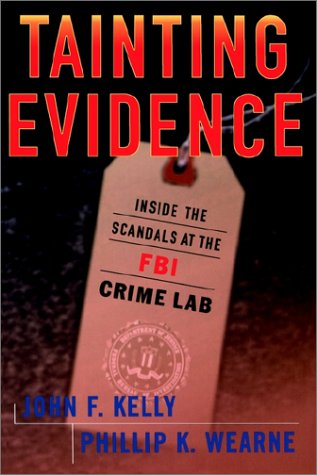
Excerpted with permission of the publisher, The Free Press, from the book, Tainting Evidence: Inside the Scandals at the FBI Crime Lab by John F. Kelly and Phillip K. Wearne.
Readers may purchase an autographed copy of the book Tainting Evidence directly from the author by sending a check or money order in the amount of $25 (shipping and handling included) to:
John F. Kelly
1832 Biltmore Street, NW, Apt. 35
Washington, D.C. 20009His email address is: KJohn39679@aol.com
Books are also available through Amazon.com.