Updated Oct. 4, 2013

Tony Musulin
It’s always about the money – but was it this time? No one had heard of security van driver Tony Musulin until he drove off with $16.7 million – France’s biggest robbery ever – without having even uttered one threatening word.
As any French cop will tell you, the weeks before a great festive occasion – Christmas, Easter, Mothers’ Day – robbers are active people. They target any place where there ought to be large amounts of cash – supermarkets, jewelry stores, gold bullion dealers, post offices, banks, and security vans. Always, they use guns as a means of persuasion – from ordinary hand-held pistols to Russian AK47s or Israeli Uzis, but when it comes to security vans, their favorite way of getting to the money is to blast their way through the armored steel with rocket-propelled grenades; the latter are easily obtained these days from former Communist Bloc countries.
Thursday, November 5, Christmas little over a month away, television and radio newsrooms in France hastily prepared a Breaking News item. A Loomissecurity van had disappeared. So too one of the van’s three guards: The driver.
So, was it such a big deal?
Not really.
The frequency of big-scale robberies made this a mundane item of news; just three months previously three men had forced a security van guard to hand over $10.1 million, and in 2007, 12 men had used rocket-propelled grenades to blow open the door of a security van and stole $14.5 million.
Yet, before that Thursday was over the disappearing Loomis security van was headline news, headline news not only in France but, with the help of 24/7 news channels like CNN, BBC-World, Sky, Fox, NBC or CBS, also so worldwide.
The Robbery
The van had disappeared in the east-central French city of Lyon.
Lyon (sometimes called Lyons in English) with its population of 4,415,000 is France’s second-largest metropolitan area after Paris. It even resembles Paris because it straddles the rivers of Saône and Rhône, as Paris does the River Seine.
The city has its fair share of crime, but Lyon is normally associated with good wine and gastronomy. The vineyards that produce France’s popular Beaujolais are north of the city and those that produce the excellent Côtes du Rhône are to the south. And it is from Lyon that French super chef Paul Bocuse hails and where, at his Michelin 3-starred restaurant, L’Auberge du Pont de Collonge, he serves his world-renowned truffle soup and whole spit-roasted pigeon at $114 and $75 per helping respectively.
However, on that warm but overcast November day, wine and food were for a moment out of the thoughts of television watchers. Loomis itself was not commenting on its disappearing security van and its driver, but criminologists in phone link-ups were telling news anchors that the “smooth” way in which the van had disappeared meant just one thing: A very experienced gang of robbers had waited outside the bank and the moment two of the three guards had gone into the bank to fetch more money, they had knocked the driver out with a stun-gun bullet, maybe with a taser, and had driven off the van, the driver lying unconscious in the rear.
This had happened, as the anchors reported, at 10:23 a.m. on a street named Rue du Vivier close to an island in the business center of town, the two rivers flowing by tranquilly on each side.
At 12:10 p.m. the van was found. It was parked on a street – Rue de Montagny – which was only a few yards from Rue du Vivier. The van’s engine was running, but its GPS (Global Positioning System), telephone link with the depot, as well as the driver’s walkie-talkie to stay in touch with the other two guards, switched off. The van was empty – of money and driver; the driver’s gun and automatic machine-gun however lay on the front seat.
Had there been doubt in some minds about who had carried out the robbery, finding the van eliminated those; it had indeed been an experienced gang and the driver, poor unfortunate man, must be lying dead somewhere.
The guard was still not named. It was presumed that the police first wanted to notify his family and prepare them for the news that he might be dead.
Friday, November 6, the clouds of the previous day had turned to rain, and it was a little cooler. That night at 8 o’clock television news anchors reported that the police had found the money, or at least, most of the money. They had found $12.9 million in a lock-up garage, called a box in France, on a street named Route de Vienne. The money in five-Euro to 100-Euro bills was piled up against a wall behind a small white Renault Kangoo van. The bills were all brand-new and still in their plastic wrappers. The police gave no indication of where they thought the rest of the money – $3.8 million – could be. Route de Vienne was a quarter of a mile from the Rue du Vivier where the van had disappeared and the Rue de Montagny where the van had been found.
The driver was now named: He was Tony Musulin, born 39 years ago in Serbia, but after almost 25 years in France, a French national.
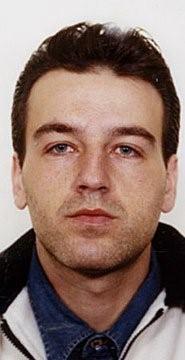 |
| THE YOUNG TONY MUSULIN |
The police released a photo of Musulin which, flashed on to television screens, drew a ah-hah! from all. With his black hair and blue eyes, Musulin was a looker. And he was wealthy too because by then no one believed anymore that he was lying dead somewhere, victim of France’s biggest ever robbery. No, he was the robber. And he had $3.8 million because, as the Lyon police chief, Claude Catto, said at a press conference, the police had no evidence of Musulin having had an accomplice or accomplices.
So, Tony Musulin had pulled off what was being called “the heist of the century” all on his own and without having fired a shot, without even having uttered one threatening word.
This was the stuff Hollywood movies were made of, Matt Damon or Leonardo DiCaprio stepping into the shoes of the gentle robber hero.
Suddenly, everyone wanted to know more about this gutsy guy. Someone even quickly started a web site in support of him, and within hours it had almost a hundred members; within days there would be thousands.
Tony Musulin had indeed become a hero. Without even having all the facts, he was being lauded for having given the banks their just rewards; they’d been stealing from us, stealing our money with their high charges and low interest rates, so good, now one of us had stolen from them.
The Gentle Robber Hero
Tony Musulin was by all appearances a model employee and a decent man.
From what his colleagues, neighbors and those who had come across him at one time or another, told the media, he had given them no indication that inside him dark waters were bubbling and about to erupt like lava from a volcano.
He lived alone in a modest rented second-story apartment in a humble pink-painted building in the Lyon suburb of Villeurbanne, some five miles from the city center. He had moved into the apartment a year previously after he had broken up with a lover, who was identified only as Hélène. The latter was the manager of a bistro and some evenings Musulin had served at the tables. “This did not happen often though, and when it did, he never talked much,” one regular patron remembered. He added that Musulin always seemed “lost in his thoughts.”
He loved Chinese food and once separated from Hélène he popped into the Vietnamese restaurant on the ground floor of the building next to his new apartment. The restaurateur described him as a big, brawny guy, but one who did not speak much. “He always replied either with a ‘yes’ or a ‘no’ to whatever I said to him.”
Someone else who also remembered Musulin as a man who never had much to say for himself was a coach at a Villeurbanne gym where he worked out regularly; the big, brawny guy weighed 220 pounds for his 5 foot 9 inches, and he wanted to keep in shape, so he pumped iron. Said the coach: “He was one of our regulars. He always paid a year in advance, and always in cash. Believe me, if he had looked like a bandit, we would not have allowed him past the door.”
And a neighbor described him as, “very gentle, not very talkative, shy. Used to walk a dog, but I’ve not seen him do so for about six months.”
Hélène also spoke about her former lover. She described him as a man who was “very ordinary, careful with money, but who all the same loved beautiful things.” They had been together for 11 years. Why did they split? “Tony had become aggressive. He carried on about everything,” she said.
Musulin’s Loomis colleagues said that he arrived at their depot every morning just before eight. He always arrived on a bicycle. The monthly salary of a junior security van guard is the SMIC (Salaire Minimum Interprofessionnel de Croissance), the French national minimum wage of $12.7 per hour for a 151.67-hour month which totals to a monthly wage of $1,927, but he had been with Loomis for 10 years and his monthly pay packet had risen to $2,500. This meant that he could afford to run a car, and he did – he had an old Peugeot 406 – but cycling the odd five miles to work, as he told his colleagues, helped him to keep his weight down.
When he got to the depot he changed from his street clothes to the Swedish-owned Loomis’s navy-blue uniform and he took possession of the pistol and automatic machine-gun he would carry for protection. At 8:30 sharp, he and two colleagues would set off on their first money transport of the day.
The colleagues said that he spoke little about himself, but the French are naturally discreet, continuing to address one another as Monsieur, Madame or Mademoiselle after having worked with or lived in adjoining apartments for years, so his discretion was not unusual. But he did some days complain to them about money, about how little they were being paid. One colleague would even remember that he one day said that he was going to make the bosses pay for their meanness. He did not say this in a threatening way and as the colleague would tell journalists, “Don’t we all say that at one time or another, say it without really meaning it?”
The Investigation
Days passed. Tony Musulin remained missing. The police were already looking foolish and incompetent because two months previously a man named Jean-Pierre Treiber had audaciously escaped from the prison in Auxerre, also in east-central France, where he had been awaiting trial for the murder of two lesbian women (See Article “Catch Me If You Can” at www.crimemagazine.com), and now they admitted, more or less, that they had no idea where Musulin and the missing $3.8 million were. Indeed, they were not absolutely certain that he had acted alone and had the $3.8 million in his possession.
But Lyon Police Chief Commissioner Claude Catto and his team were indeed making progress with their investigation, but keeping the information to themselves, hoping to give Musulin confidence to step from his hiding place and into their waiting handcuffs.
First confirmation the police had that Musulin did indeed have the $3.8 million with him came the very next day after the heist – Friday, November 6.
The plastic bags in which the missing money had been packed were found in a garbage bin on a street in Bron, another of Lyon’s suburbs. Bron is south of Villeurbanne and it is that way that one would have to drive if one was heading south – south to Italy beyond which was the former Yugoslavia from where Musulin hailed. Checking the bags for fingerprints, the police had found Musulin’s. So, yes, he had the money alright.
Commissioner Catto had also put together a time line of Musulin’s movements that went back almost a year to January 2009.
From January to March, Musulin had done little more than pump iron and eat Chinese food and to make sure that no one laid their grubby hands on the money he transported in the white Loomissecurity vans.
In April, he had under his own name rented the lock-up garage on Lyon’s Route de Vienne. The lease was to run through to Thursday, December 31, 2009.
That month he had also rented, and also under his own name, the small white Renault Kangoo van which was to be found with the money in the lock-up garage.
At the start of May he had taken a few days vacation and on Wednesday, May 6, he had set off for Serbia by car. He had made the journey in a Ferrari. The car was his; he had bought it at an auction in Lyon in 2008, paying $166,000 by check for it. (The law in France is that any purchase for a sum of more than €3,000 ($4,500) must be settled by check or credit card.)
Two days later, on Friday, May 8, he had returned to France by tourist coach, and back in Lyon, he had declared the Ferrari stolen to its insurers.
From May to September, Musulin had again done little more than ride his bicycle to Loomis in the morning to be a model worker, and to pump iron and to eat Chinese food, but in the last week of October he had withdrawn whatever money he had on deposit in the bank. He had several (some reports spoke of 12) accounts in banks in Lyon and Villeurbanne, and in them he had had a total of €100,000 ($144,000).
On Sunday, November 1, he had rented a BMW 900 motorcycle in Lyon. He took it for four weeks and paid cash; the rental cost was $995 per week which included the insurance.
That same day he had returned the small white Renault Kangoo van to the car rental company (CarGo). The body of the van was badly burned and his explanation was that young hoodlums must have torched the car which he had left parked on a street not far from his apartment. (Youths torching cars is a regular occurrence in France, it happens when peaceful social demonstrations turn violent, but also after football matches when there is discontent after a defeat, or when too much alcohol has been consumed on festive nights.) Told by the manager of the car rental company that he would have to report the torching to the police, he had not hesitated to do so; he had even called in at a police station house twice about it, each time confirming his identity with his real French identity card. The company, satisfied that their insurer would reimburse them for the van, had allowed him to rent another.
On Wednesday, November 4 – the day before the robbery – Musulin had invited one of his colleagues, Philippe Ferreiro, 47, to join him for a drink after work. Ferreiro could not go which, as he told the Lyon-based daily Le Progrès, he now regrets. “I told him ‘not today, pal, but certainly another day.’ I think he wanted to sort of bid me goodbye. That it was going to be a farewell drink.” Ferreiro had been a security van guard for seven years but with Loomis he’d been for just a year, and he and Musulin had formed a team along with a third man who was identified only as Didier M., 27 years old, for only a few months; Musulin had quarreled with his previous two team mates. (The reason for the quarrel has not been revealed.)
Perhaps that day Musulin had also removed all his belongings (clothes, household equipment and personal things like letters, old electricity bills, CDs and books) from his rented apartment, leaving only those items of furniture (fridge, stove, sofa, bed) too large and heavy for one man to move, behind for the cops to find. And he had cleaned the place; the fridge was empty and shiny; the stove had been scrubbed; the floor polished; the furniture dusted.
On Thursday, November 5 – the day of the robbery – Musulin had arrived at the depot on his bicycle as usual and after having clocked in, having changed into his uniform and having signed for his gun and sub-machine gun, had set off at 9:15 a.m. with Ferreiro and Didier M. Musulin, senior to both men, was as usual behind the wheel, the other two in the rear of the van. Their first stop was at the Lyon depot of the Banque de France, France’s central bank founded in 1800 by Napoléon Bonaparte, to pick up money. With Musulin remaining at the wheel, Ferreiro and Didier M. had rushed into the bank, each cradling his sub-machine gun in the crook of one arm while the hand of the other rested on the gun holstered on his hip. Despite that insurance companies in France include a clause in their contract with security van companies that they should not transport more than €7 million ($10.1 million) at a time, the three had collected $16.7 million. It was common practice to ignore the 7-million maximum clause, and as a policeman, who was not identified, told journalists: “What’s important is that no one on the outside knows how much money is inside.” And as a former Loomis security van guard, who did not want to be identified, told journalists: “Always when we left the Banque de France with a large load of money, we made it straight back to the depot.”
On that Thursday, this was not what had happened. The three guards had to pick up another bag of money from a bank, the bank on Rue du Vivier. Again, Ferreiro and Didier M. had rushed into the bank, and they had emerged about three minutes later and … the van was gone.
Ferreiro and Didier M.’s first thought had been for their colleague; they thought that the van with him in it had been hijacked. They called his walkie-talkie. There was no reply. They called him on his cell phone. Again there had been no reply. They then called their depot on their walkie-talkie and reported that the van and Musulin were gone. Ferreiro would tell Le Progrès that Musulin had been complaining of an upset stomach all of the previous week and his first thought was that he had been taken very ill suddenly and had pulled the van into a more secluded spot to vomit.
The brand-new bills were packed into 49 bundles, each bundle wrapped in heat-and-water resistant plastic.
There was no record of the numbers on the bills.
Questions but No Answers
How could a man with a monthly salary of $2,500, afford a $166,000 Ferrari? The police admitted that this puzzled them as much as it did everybody else.
How could a man with a monthly salary of $2,500 have $144,000 in the bank? The police admitted that this too puzzled them as much as it did everybody else. One cop with a sense of humor told this writer, that he would “sure like to know because if it were honestly achieved, I am going to do it too.”
Did Musulin really plan and execute the heist all on his own? Again, the police admitted that they just did not know, but that they were looking only for Musulin. They had, they said, asked Interpol, the international criminal police organization, to issue an international arrest warrant for him. This was giving them confidence that Musulin would soon be behind bars because as soon as he tried to pass through custom’s control of a non-Schengen country he would instantly be arrested. (In 1985 five of the then 10-member European Community, today the European Union, signed the Schengen Agreement under which border controls for their nationals travelling to or from the signatory states would be eliminated. Currently (2010) 25 European Union states have signed the Schengen Agreement; a notable absentee is the United Kingdom.)
Where could Musulin be, and where was the missing money? Yet again, the police had to admit that they did not know. Lyon was only 93 miles from Geneva and he would not have to go through customs to get there because Switzerland, despite not being a European Union member state, had signed the Schengen Agreement. Milan and Turin were 155 and 192 miles respectively from Lyon, and Italy, a European Union member state, had also signed the Schengen Agreement. Paris was 285 miles away and with almost 12 million people living in the city and its suburbs (2007 census data) it would not be difficult to hide among them.
The police were also not revealing how they knew what they did know about Musulin.
How did they know about the lock-up garage? The agency through which he rented the garage had told them.
How did they know about the rented small white Renault Kangoo van and the rented BMW 900 motorcycle? The manager of the car rental company had told them.
How did they know that plastic Banque de France bags had been thrown away? A passerby had seen them protruding from the garbage bin on the street in Bron and on seeing that they were Banque de France bags had summoned the police.
How did they know about Musulin’s bank accounts? The banks had told them.
How did they know about Musulin’s trip to Serbia? Suspecting that he would be heading that way with the $3.8 million, they had asked the Serbian authorities to check if a Tony Musulin had entered the country through any of its borders. (Serbia is not a European Union member and had therefore not been invited to sign the Schengen Agreement.) The Serbs had done more than that; not only had they checked their passport control records and had found that he had entered the country, but on Wednesday, May 6, but they had also run through videos taken by spy cameras at border posts and had seen that he had checked through the Bosnian/Serbian border behind the wheel of a Ferrari. Further checking had revealed that he had left Serbia again two days later on Friday, May 8. He had done so as passenger on a coach, a favorite means of transport in Europe with poor immigrant workers because of its low fares.
Giving himself up
Monday, November 16 was a warm and sunny day on the French Riviera.
 |
| POLICE MUG SHOT OF THE ARRESTED TONY MUSULIN |
At noon, in the Mediterranean city of Nice, restaurateurs on its elegant Promenade des Anglais were laying tables on flowery terraces; they knew that many people would be strolling along the promenade and at noon they would want to have a bite to eat.
Thirteen miles west from Nice in the Principality or City-State of Monaco restaurateurs were also preparing for hungry tourists.
In the 1950s the English playwright and novelist, Somerset Maugham (1874-1965) had called the 0.77-sq.mile, tax-free Monaco, the world’s second smallest state after the Vatican City, “a sunny place for shady people.” Ruled by the noble family of Grimaldi since the 13th century, it has always been a grain of sand in the eye of its big and only neighbor – France. The French head-of-state General Charles de Gaulle had even in the 1960s threatened to invade and annex it should it not clean up its act. The act that the General wanted cleaned up was that wealthy French nationals established residence in the Principality to avoid paying revenue tax in France. The General was victor and the Principality’s French nationals must now pay tax. Since those days of threats of invasion and annexation, the Principality and France are on the best of terms. The Principality does not have a ground army or air force, and its navy consists of one coastal patrol boat, but it does have a powerful police force of 515 men in operetta-type dark blue uniforms with red and gold braid for a population of 33,000.
Crime is however almost non-existent in the Principality. What crime there is consists of a motorist speeding down one of the Principality’s narrow streets in a luxury car, or a late-night clubber who has had one drink too many being a little noisy for the likes of a billionaire trying to sleep in one of the high-rise multi-million dollar apartments.
In fact, only once in the past 100 years has a serious crime been committed there; in 1999 American Ted Maher was accused and convicted of the willful murder of billionaire banker Edmond Safra.
The Monaco police can’t therefore be described as tough, trigger-happy cops, so when, the glass door of its main station house opened at 12:45 p.m. that Monday, November 16, the duty officer greeted the man who walked in politely and asked what he could do for him. Through the glass of the door behind the man the duty officer could see a BMW 900 motorcycle. The man, gray-haired, unshaven and dressed all in black, was obviously a biker: Maybe he was lost and had stepped in for directions.
“Good afternoon. My name is Tony Musulin,” said the man.
On the run for 11 days, Musulin had gone to give himself up.
At 4:30 p.m. Monaco Police Chief André Muhlberger called a press conference.
Muhlberger, smiling broadly, confirmed that the fugitive had handed himself in to the police of Monaco.
 |
| TONY MUSULIN ON HIS ARREST |
Musulin had arrived, said Muhlberger, on a BMW 900 motorcycle. No, he had not explained where he had been for the previous 11 days. No, he did not have the missing $3.8 million with him. In fact, he did not have even one cent on him and by his unshaven appearance and that he was famished, he must have been without money for quite a while. His unshaven appearance – and the gray hair whereas the picture of him showed a black-haired man – had made it a little difficult to be absolutely certain that he was indeed who he claimed to be, but he had his passport with him and they had taken his fingerprints and his identity had thus been confirmed.
The journalists wanted to know whether they could speak to Musulin. No, replied Muhlberger, that would not be possible. After having confirmed Musulin’s identity, they had handed him over to the French police. The transfer had taken place among the cacti of Monaco’s Jardin Exotique – the botanical garden – once the pride and joy of the mother – the former Hollywood star Grace Kelly – of the current ruler, Prince Albert 11. What few people were aware of was that the botanical garden acted as border between the Principality and France.
It turned out that Interpol had not yet issued an international arrest warrant for Tony Musulin, so the Monaco police did not have the jurisdiction to take him into custody.
Had he surrendered to the Monaco police hoping to launch a long extradition battle, the journalists wanted to know from Muhlberger.
“No,” he replied, “he was confused and gave us the impression that he was not aware that he was in Monaco. He thought that he was in France.”
He added: “After we’d told him that he was in Monaco, all we could do was to ask him whether he would object to us handing him over to the French police, and as he had not objected, we had proceeded to drive him to the border where we handed him over.”
But before the handover they had given Musulin a sandwich and a cup of coffee; he was hungry and it was lunchtime after all.
Back to Lyon
The moment Musulin was in the hands of the French police, he was driven to Nice and from there the 290 miles to Lyon where he arrived at 11 p.m. He sat silently in the rear of the police car.
During his first interrogation the following morning – Tuesday, November 17 – he admitted to the police that he was the one who had robbed the Loomisvan. Whether he acted alone he refused to say. Likewise he refused to say where he had hidden the missing $3.8 million: He would not even admit that he had the money. He had stolen the contents of the van, yes, but not a word further would he say.
On Wednesday, November 18, Musulin appeared briefly in court in Lyon and heard that he was to stand trial at a future date for theft and fraud; the latter charge could be added because the “stolen” Ferrari had been found in Serbia with the man Musulin had sold it too. The police did not reveal the amount the man had paid for the car. (There exists a lucrative traffic of stolen luxury cards between Western Europe and the former Communist Bloc countries.)
Musulin was taken from court to Lyon’s Corbas Prison. Corbas, described as ultra-modern – each cell has a shower and an intercom so that inmates can summon help – was inaugurated in May 2009 by France’s then Minister of Justice Rachida Dati. In her speech she described Corbas as the “prison for the future.” She added: “When one is deprived of one’s liberty, one ought not to be deprived of one’s dignity as well.” Despite such words, Corbas has already experienced several rebellions. On Tuesday, November 24, not even six months into its existence, 200 inmates had refused to return to their cells after a walk in the exercise yard. It took two hours to calm them down and to get them back into their cells. That next Sunday and the following two as well, some inmates had again refused to return to their cells from the exercise yard. The reason for the rebellions was overcrowding despite that there were only 805 inmates at that time for a maximum capacity of 690, and that there were no individual cells.
 |
| THE POLICE FOUND SOME OF THE MONEY IN A LOCK-UP GARAGE |
On Thursday, December 3, Musulin briefly broke his silence to tell his interrogators that he had left all of $16.7 million in the lock-up garage. More he would not say, but it did sound as if he was saying that those cops who had been first into the garage had helped themselves to the money. Just a few days previously television news anchors had shown two cops holding up a small shop in a French town and rushing off with the contents of the cash register; the shop’s spy cameras had filmed it all. (The cops were suspended and are now awaiting trial.)
On Tuesday, December 15, Loomis sacked their Lyon bureau chief as well as the branch’s chief of transport. They furthermore demoted the man who had been in charge of transports on the day of the robbery, while two guards received warnings to improve their vigilance or to face dismissal. Philippe Ferreiro and Didier M. were suspended, but only temporarily; Ferreiro is back at work now, but Didier M. described as “traumatized” is off on sick leave.
What was it all about?
Did the sheer volume of plastic-wrapped bundles of money overwhelm Musulin so that he ran leaving the money in the lock-up garage?
Did he have an accomplice or accomplices – the Russian Mafia maybe – who were to pick up the money and deliver his share to him in his hide-out?
Where was this hide-out supposed to have been? The road from Lyon to Serbia runs south to the French Riviera (and Monaco). Belgrade, capital of Serbia is 910 miles or a 14-hour drive from Lyon. After the French Riviera a motorist has to head for Turin, then Milan, then Trieste, and from there to and through Croatia to reach Serbia.
Only Musulin knows the answers and he is not talking. One of his two lawyers, Christophe Cottet-Bretonnier, says that Musulin is a loner who had even broken all ties with his own family but that the wandering life and living hidden are not for him. “He seems relieved that he had surrendered,” he said.
To Be or Not To Be a Hero
Although the man who had walked into the Monaco police station house was plumper, older-looking and grayer than the Tony Musulin on the photo the French police had initially released of him, he remains a hero. His Facebook page continues to attract friends and has more than 13,000 already. Every day more people from the world over join his fan-club. Someone has even started to sell Tony Musulin t-shirts on the Internet with a picture of his face above the slogan “Best Driver 2009”; these are selling for $30 each.
According to Maître Cottet-Bretonnier (in France a lawyer is addressed as Maître) his client knows that he is being considered a hero.
“It amuses him,” he says.
Something which is not amusing Musulin however, is that his heist has revealed that he has an 18-year-old daughter. Her existence became known when a few days after the robbery a girl reported that someone had tried to kidnap her. Her story was that someone had tried to force her into the rear seat of a car but when a motorist driving by had sounded the horn of his car the kidnapper had let go of her. The girl’s surname was not Musulin, but she had, for the first eight years of her life, borne that surname. She did not immediately make the connection between the Musulin who had fathered her and the Musulin who had carried out the robbery, but, although the police have not confirmed this, she did then learn that Tony Musulin was her biological father. She now has a bodyguard despite that Musulin has not admitted in so many words that he did father her; he only admitted to his lawyers that he did in the past know her mother. The police did however say that they could not find any eyewitnesses to the attempted kidnapping.
But even if Musulin should be the father of a teenager, he still remains a hero. His two lawyers say that he is receiving dozens of letters each week from people – male and female – who congratulate and compliment him on his extraordinary feat and his non-violence.
Some of the female letter writers have asked him to marry them, enclosing photos of themselves.
This, too, amuses him.
What Now For Musulin?
Despite the amount that Tony Musulin had stolen, because no guns or violence had been involved, by French law he had committed only a minor crime.
 |
| CORBAS, FRANCE'S NEW PRISON |
Therefore, under Article 311-3 of the French Penal Code he risks a maximum of only three years in prison and a fine of €45,000 ($65,000). Had he branded a gun at his two colleagues, he would have faced a 30-year sentence and a €150,000 ($216,000) fine. The maximum penalty for a fraudulent insurance claim is five years and a fine that reflects the value of the alleged stolen item.
Legal experts however think that Tony Musulin would receive no more than 18 months in prison and once his pre-trial detention time had been deducted, he ought to be a free man within nine moths of having been sentenced.
As another French law stipulates that a minor felon must be awarded pre-trial bail, he would not have to await his trial in jail; he would be leaving Corbas Prison within weeks.
Then all those women who had offered him matrimony will be waiting.
But will they have him without the $3.8 million?
Hero? Robin Hood? Nice guy?
At 9 a.m. on Tuesday, May 11, rain pelting Lyon, a prison’s transport van with grayed windows swung through the gates of the city’s Court of Justice. The lights of 60 cameras had flashed almost simultaneously as the van had approached the building, but none had succeeded in getting a photograph of the van’s occupants, three uniformed cops and a man in dark trousers, black woolen sweater and a gray windbreaker: Tony Musulin. His trial for “robbery without violence” and “insurance fraud” was scheduled to open at 9.30 that morning.
The court room was packed. A week earlier the media had reported the date of Musulin’s trial, and there, that Tuesday, not only women wanted to see what he looked like, but so too men. All ages were there, filling the courtroom’s hard, uncomfortable benches.
Outside the court room, Maître Claudia Chemarin-Maisonneuve, Loomis’s lawyer, was telling journalists that the Swedish security van company had never had a problem with Tony Musulin and therefore had not given him a hard time as some of his colleagues had told journalists. She described him as a “discreet and punctual” employee. She said: “No one had any suspicions of Tony Musulin when he asked us to change the route he was to take with his security van that day of the heist. “
At 9.26 a.m. Musulin’s two lawyers, Christophe Cottet-Bretonnier and Hervé Banbanaste entered the court room and at 9.46 a.m. so did Jean-Hugues Gay, who would preside over the judge-only trial. While they took their seats, the photographers who had been outside, rushed in for a quick photo session. They took photos of the lawyers and the judge, and then of the box of the accused, but not of the accused. He was waiting in an ante-chamber until the photographers and journalists could be marched from the court room; he had requested that no photos be taken of him, and that was his right by French law.
The Tony Musulin an artist working for a local newspaper captured on a sheet of white paper later showed a fat, balding man with only a few strands of wispy gray hair behind his ears and in his neck, and a bloated face covered in an untidy gray beard. And the ice-blue eyes which had stared at the world from his Loomis I.D. photo with a child-like innocence had turned a dull gray. In the five months that he had spent in Corbas prison, he had lost his looks. Indeed, had he looked like that – an overweight aging guy – on the day that he had driven off with $16.7 million, he would never have become a national hero and an international Internet star. It was hard to believe that he was still only 39.
Two psychiatrists, Liliane Daligand and Marc Lavie, had assessed Musulin during his incarceration. At first he had refused to be assessed, which was also his right by French law, but had then agreed to one consultation that would take no more than 90 minutes. He had told the two that he was like a little dog. He said: “If you caress me, I am gentle. If someone is nasty to me, I bite.” They had come to the conclusion that such an attitude had made him a loner. They said however that despite having cut himself off from others, he had a desire to be noticed which he had always achieved by doing something spectacular.
It was a diagnosis that made sense. Musulin rode to work on a bicycle, yet, at one time his colleagues knew that he was the owner of an expensive Audi, and then later of a Ferrari.
Musulin had his own explanation of his character and of why he had robbed Loomis which he did not fail to pass on to the two psychiatrists. He spoke of his childhood. Contrary to what had been reported at the time of the heist, he was born in France, in the commune of Saint-Martin-d’Hères close to the Swiss border of immigrant Yugoslav parents. His parents had often returned to Yugoslavia for lengthy periods and he had been obliged to leave his French school to accompany them; they had not given him much attention or love, he claimed. At 16, he had passed his school-leaving exam here in France and had then gone to an electro-technical college to qualify as an electrician. Ten years later he had joined Loomis as a security guard. He had been able to buy a Ferrari, he’d told the two psychiatrists because he worked hard and spent little. “I am a self-made man,” he had boasted.
In court, that was his line too. He had six bank accounts and €130,000 ($162,000) on deposit, because he’d worked for the money. (It had been reported that he had 12 bank accounts and €100,000 ($144,000) when, in fact, he had fewer accounts but more money.)
He had, he also said in court, driven off with the security van to get back at Loomis. “I had enough of my boss and the company.”
Why was that so? He said that Loomis paid him and his colleagues too little for such dangerous work and on top of that the company’s security was slack. Also, because he was a single man and without children, the company would never agree for him go on vacation in the summer. The company had also refused to give him a few hours off in order to attend the funeral of a close friend. He had attended the funeral all the same and the company had then started to be tough on him. “They sent me to places where the others would not go,” he said.
He had planned the heist in the summer of last year (2009) when he’d been told yet again that he was to work right through the summer to allow men with wives and children to profit from the two-month school vacation.
In reply to such accusations, Maître Chemarin-Maisonneuve repeated what she had told journalists earlier outside the court: Musulin had been a model employee and there had been no conflict between him and Loomis. His claim of wishing to get back at Loomis was therefore not true. She also denied that Loomis was slack when it came to security.
But Musulin did not budge. He was, he said in court, not the hero, the Robin Hood the media and Internet had made him out to be. He was just an ordinary guy, society’s “little guy” who the bigger guys picked on. And the bigger guys were his bosses at Loomis so that he had to look out for himself. “I respect the law but at a certain moment I crossed over to the other side because of all the injustices,” he said.
He did not want the money he had stolen, he emphasized. He had taken it only to spite his employers.
Where was the missing $3.8 million?
“I don’t know,” said Musulin. “I don’t have it.”
He had the people in the public gallery laughing when he spoke of the money. He described something like a scene from the 1960’s Peter Sellers movie, The Pink Panther, when he spoke of the moment when he had to transfer the bags of money from the Loomis security van to the small white Renault Kangoo van he had rented specially for the heist. He said: “I was throwing the bags into the van. They would not lie where I wanted them to. They were slipping; they were plastic bags, so they were slipping, sliding from the van, dropping everywhere. It was crazy! I really had a tough time!”
He also stuck to his story that he had left all the bags of money in the lock-up garage he had rented; at least he had left whatever he had had in the Renault Kangoo in the garage, but some of the bags might have fallen under the Kangoo during the transfer from the Loomis security van, and those might have remained lying on the road. Or, he said, someone had stolen the missing bags from the garage. He hinted that the police should maybe have a word with the man from whom he had rented the garage. “I’m telling you, I don’t have the money,” he emphasized when Judge Gay pointed out that the missing money were all in large bills of 500, 200 and 100 euros.
He also had nothing to say about where he had been for the time that he had been on the run. All that he would say was that he’d rented a motorbike and had ridden to Italy. He had only his own money on him while he was on the run and it was not a large sum, he pointed out. Therefore while in Italy he had done nothing but “eat a lot of pasta.”
The trial was scheduled to last at least two days. It lasted just one.
Marc Desert, the public prosecutor, had asked Judge Gay and his team of two assessing magistrates to sentence Musulin to a total of five years for the two crimes. The three had deliberated for just under two hours (during which some time was spent on having a coffee and using the toilets) and returned with a verdict of three years and a fine of €45,000 ($56,000).
Musulin, on hearing the verdict, smiled, but Prosecutor Desert shook his head in disbelief, and once out of his black robe and speaking to journalists outside the court room said that French justice was not going to allow Musulin to recoup the missing money he had “hidden somewhere in Eastern Europe” once he’d done his time. He said that he would be appealing the lenient sentence and the following morning of Wednesday, May 12, he did. Musulin’s two lawyers though said that they would not appeal the sentence.
Tony Musulin would therefore have to have another day in court, but no matter what the new verdict will be, he could, when he is a free man again, go and fetch the money and live happily ever after because of the procedural defense system of double jeopardy which means that an already judged crime can not be rejudged. Most developed countries (U.S.A and Britain included) abide by the double jeopardy system. France also does: All Council of Europe countries, which include almost all European Union countries, are signatories of the European Convention of Human Rights which protects a convicted person from facing a double jeopardy, in other words from being tried more than once for the same crime.
It is unlikely that Prosecutor Desert will be successful in having Musulin’s sentence lengthened. Musulin had after all received the maximum sentence for “robbery without violence” and was heavily fined for the insurance fraud he had committed.
Therefore, after the five months that Musulin had spent in jail awaiting his trial have been deducted from his 3-year sentence he could be walking from prison in two and a half years – around December 2012.
But another six months could be deducted from his sentence for good behavior which means that he could be released in July 2012.
Tony Musulin might then finally be able to go on a summer vacation. And perhaps as a millionaire.
Free … and perhaps a millionaire:
On Tuesday, November 2, 2010, Musulin’s attorneys, having changed their minds about not lodging an appeal, had Musulin back in the dock at the courthouse in Lyon for an appeal hearing.
To the delight of Marc Desert, the public prosecutor, the appeal went against the charismatic thief’s three-year sentence and he was to do five years behind bars. (In France, in 99 of 100 cases, an appeal is unsuccessful.)
Musulin was returned to Lyon’s Corbas penitentiary but was soon afterwards transferred to Paris’s La Santé penitentiary. At Lyon-Corbas he had to be held in solitary because the other detainees did not let a day pass without trying to get from him where he had hidden the missing $3.8 million of the $11.7 million he had stolen. At times their persuasion had been physically violent. On his arrival at La Santé he again had a cell of his own.
Having been given five years that November 2, 2010, but having done six months waiting for the commencement of his original trail plus the six months he had already served of the three-year sentence waiting for the appeal to be heard, he was to be due for release in May 2015.
In 2012 Musulin was back in the news with a book about him and a movie about the extraordinary heist he had carried out.
Then followed oblivion until Thursday, October 3, 2013 when the news hit the headlines that Toni Musulin had been released.
He was released on Saturday, September 28. He was photographed being driven from the prison by Hervé Banbanaste, one of his attorneys. He had a padded jacket pulled up to his pale, lined face, his eyes hidden behind large sunshades, and his hair, grey and long. Where he was driven to has not been revealed.
Musulin had done three years of the five year sentence. Such an early release was described by legal experts as “according to the law of France.”
While the French digested the news with disbelief and the police with anger, Public Prosecutor Marc Desert told the weekly news magazine, VSD: “Musulin will not be allowed to enjoy the missing $3.8 million.”
Musulin is however free to leave France and to travel wherever he wants.
Few in France believe that he had, as he claimed, abandoned all of the stolen money in that lock-up garage.
Just as they now believe that he had deposited it somewhere outside France in a bank and he will from now on live the life of a millionaire.
The police however plan to have the last word.
“We’ll get Musulin, even if it will only be for money laundering,” French television networks quoted an anonymous police source.