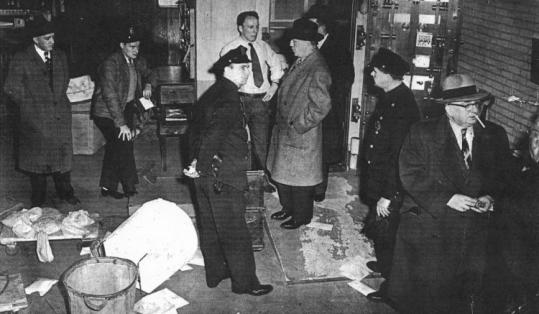
At the time, the Brinks heist in Boston was called "the crime of the century." The take of over $2.7 million was the largest in U.S. history, but it was the cold, calculating efficiency of the robbery that so stunned and intrigued the nation.
by J.J. Maloney
On January 17, 1950, at 7:30 p.m., a group of armed robbers walked away from the Brinks Building, at 165 Prince Street in Boston, with $1,218,211.19 in cash and more than $1.5-million in checks, money orders and other securities.
It was a textbook robbery – the largest in U.S. history at the time. There had been seven robbers – all wearing Navy P-coats, gloves and caps, and Halloween masks. They wore rubbers and crepe-soled shoes.
The robbers said little and knew exactly what they were doing. They'd come through a series of locked doors to reach the second floor, where Brinks employees were counting and storing money.
The only evidence was a chauffeur's cap one of the robbers left behind, and the tape and rope they'd used to gag and tie up the employees. They also took four revolvers from the employees.
The Boston police rousted every known hoodlum in the city – and other American cities checked out their prominent criminals.
It was billed as the ''crime of the century'', as so many stunning, jaw-dropping crimes are. Brinks offered a $100,000 reward for information leading to the arrest and conviction of the robbers.
Ex-cons began to tell the FBI of conversations they'd heard in prison about plans to rob Brinks. They all turned out to be false. Other criminals, facing charges, volunteered to solve the crime if the FBI would only turn them loose.
While questioning people in the area of the Brinks building, the FBI learned that a 1949 green Ford stake body truck, with a canvas top, had been parked near the Prince Street door of Brinks around the time of the robbery.
On Feb. 5, 1950 some boys found several guns on a riverbank in Somerville, Mass. One of the guns had been taken from a Brinks employe during the robbery. A month later pieces of a green Ford stake body truck, cut up with a torch, were found in Stoughton, Mass. The truck had been stolen in Boston in November, 1949. Several suspects in the Brinks robbery lived in Stoughton.
Among the early suspects were a number of well-known robbers and criminals from the Boston area, such as Anthony Pino, Joseph McGinnis, Joseph ''Specs'' O'Keefe and Stanley Gusciora. A number of these suspects just happened to have alibis that involved them going somewhere at 7 p.m. the day of the robbery.
O'Keefe and Gusciora lived near Stoughton, and after the green Ford truck was found, they came under intense scrutiny.
In June, 1950, O'Keefe and Gusciora were arrested in Pennsylvania, with burglary loot (unrelated to the Brinks job) in their car. O'Keefe was sentenced to three years in the Bradford County Jail. Gusciora was acquitted in Bradford County, but convicted in McKean County, Pa., and sentenced to 5 to 20 years in the Western State Penitentiary at Pittsburgh.
Law enforcement kept hearing rumors that O'Keefe and Gusciora were putting pressure on Boston hoodlums for money to fight their convictions – among those frequently mentioned were Pino, McGinnis, Adolph ''Jazz'' Maffie and Henry Baker.
The FBI visited with O'Keefe and Gusciora, hoping they'd become bitter at their crime partners and talk, but both men claimed ignorance of the Brinks robbery.
A federal grand jury had hearings in late 1952, but issued a report the following January that said it lacked sufficient evidence to indict anyone. (Ten of the 11 men ultimately indicted had appeared before this first grand jury.)
The federal government tried to deport Pino, but he successfully fought deportation when the Supreme Court ruled on April 11, 1955, that a criminal conviction the government had tried to use against Pino ''had not attained such finality as to support an order of deportation.''
When O'Keefe finished his sentence in Towando, Pa., he was taken to McKean County to stand trial for burglary, larceny and receiving stolen goods, as Gusciora had done before him. O'Keefe also had a parole-violation detainer from Massachusetts, for carrying a concealed weapon in 1945.
In McKean County, O'Keefe was released on $17,000 bond. He returned to Boston and was released on bond in the probation-violation case.
On the streets, O'Keefe continued to try to get money from other suspects in the robbery, and he seemed bitter toward some of them.
O'Keefe returned to Pennsylvania for trial, was convicted, posted an appeal bond, and returned to Boston. Shortly afterward, Maffie was convicted for income-tax evasion and sentenced to nine months in a federal prison. Obviously, law enforcement was keeping pressure on the suspects.
On May 18, 1954, O'Keefe and a friend held Vincent Costa (related to Pino) hostage and demanded money. The FBI says a small ransom was paid and Costa was released. Afterward, Costa, O'Keefe and O'Keefe's friend all denied that any such event had occurred.
On June 5, 1954, as O'Keefe was driving in Dorchester, Mass., a car pulled along side of his and sprayed his car with bullets, but he escaped unharmed. Nine days later there was a shooting incident between O'Keefe and Baker, but again no one was hit. Two days after that, again in Dorchester, Mass., Elmer ''Trigger'' Burke – a professional hit man – was given the assignment to get rid of O'Keefe, and did a little better. Using a machine-gun, Burke managed to hit O'Keefe in the chest and wrist – but O'Keefe survived.
The next day (June17, 1954) Trigger Burke was arrested, charged with possession of a machine gun, which proved to be the one used to shoot ''Specs'' O'Keefe.
In August of 1954 O'Keefe was sentenced to 27 months in prison on the probation violation for carrying a concealed weapon. Later that same month, Trigger Burke escaped from jail with the help of outside friends – one of whom was strongly suspected to be Pino. After only a couple of days freedom, Burke was arrested in South Carolina and sent to New York, where he was convicted and executed for murder.
The friend who had helped O'Keefe hold Costa hostage disappeared, and was never found.
The FBI, suspecting that O'Keefe would be the weak link because there was a contract out on his life, continued to visit him in jail. Agents visiting him in October, 1954, noticed that the missing friend was bothering O'Keefe, and he suggested that Pino would be in trouble when O'Keefe was released from jail.
The FBI began to visit with O'Keefe more often and, finally, on Jan. 6, 1956, he cracked. ''All right,'' he said, ''what do you want to know.''
The Planning of the Brinks Robbery
In December, 1948, Brinks moved from Federal Street to 165 Prince Street in Boston. Almost immediately, the gang began laying new plans. The roofs of buildings on Prince and Snow Hill Streets soon were alive with inconspicuous activity as the gang looked for the most advantageous sites from which to observe what transpired inside the Brinks offices. Binoculars were used in this phase of the ''casing'' operation.
Before the robbery was carried out, all the participants were well acquainted with the Brinks' premises. Each of them had surreptitiously entered the premises on several occasions after the employees had left for the day. During their forays inside the building, members of the gang took the lock cylinders from five doors, including the one opening onto Prince Street. While some gang members remained in the building to ensure that no
one detected the operation, other members quickly obtained keys to fit the locks. Then the lock cylinders were replaced. (Investigation to substantiate this information resulted in the location of the proprietor of a key shop who recalled making keys for Pino on at least four or five evenings in the fall of 1949. Pino previously had arranged for this man to keep his shop open beyond the normal closing time on nights when Pino requested him to do so. Pino would take the locks to the man's shop, and keys would be made for them. This man subsequently identified locks from doors that the Brinks gang had entered as being similar to the locks that Pino had brought him. This man claimed to have no knowledge of Pino's involvement in the Brink's robbery.)
Each of the five lock cylinders was taken on a separate occasion. The removal of the lock cylinder from the outside door involved the greatest risk of detection. A passerby might notice that it was missing. Accordingly, another lock cylinder was installed until the original one was returned.
Inside the building, the gang members carefully studied all available information concerning Brinks' schedules and shipments. The casing operation was so thorough that the criminals could determine the type of activity taking place in the Brinks' offices by observing the lights inside the building, and they knew the number of personnel on duty at various hours of the day.
A few months prior to the robbery, O'Keefe and Gusciora surreptitiously entered the premises of a protective alarm company in Boston and obtained a copy of the protective plans for the Brinks building. After these plans were reviewed and found to be unhelpful, O'Keefe and Gusciora returned them in the same manner. McGinnis previously had discussed sending a man to the U.S. Patent Office in Washington, D.C., to inspect the patents on the protective alarms used in the Brinks building.
Considerable thought was given to every detail. When the robbers decided that they needed a truck, it was resolved that a new one must be stolen because a used truck might have distinguishing marks and possibly would not be in perfect running condition. Shortly thereafter – during the first week of November – a 1949 green Ford stake-body truck was reported missing by a car dealer in Boston.
During November and through mid-December, 1949, the robbers repeatedly practiced their approach to and getaway from the Brinks building. Once the dry runs were concluded, they felt ready to strike, but only if conditions at the Brinks building were optimal. To determine those conditions, Costa – equipped with a flashlight for signaling the other men – was stationed on the roof of a tenement building on Prince Street overlooking Brinks. From this lookout post, Costa could determine better than the men below whether conditions inside the building were favorable to the robbers.
During the six weeks preceding the robbery, they made approximately a half-dozen approaches to Brinks. On each occasion, the gang decided to postpone the robbery because conditions at Brinks were not optimal.
The last ''false'' approach took place on Jan. 16, 1950 – the night before the robbery.
The Brinks Robbery
At approximately 7 p.m. on January 17, 1950, members of the gang met in the Roxbury section of Boston and entered the rear of the Ford stake-body truck. Banfield, the driver, was alone in the front. In the back were Pino, O'Keefe, Baker, Faherty, Maffie, Gusciora, Michael Vincent Geagan, and Thomas Francis Richardson.
During the trip from Roxbury, Pino distributed Navy-type P-coats and chauffeur's caps to the other seven men in the rear of the truck. Each man also was given a pistol and a Halloween-type mask. Each carried a pair of gloves. O'Keefe wore crepe-soled shoes to muffle his footsteps; the others wore rubbers.
As the truck drove past the Brinks offices, the robbers noted that the lights were out on the Prince Street side of the building. This was in their favor. After continuing up the street to the end of the playground which adjoined the Brinks building, the truck stopped. All but Pino and Banfield stepped out and proceeded into the playground to await Costa's signal. (Costa, who was at his lookout post, previously had arrived in a Ford sedan which the gang had stolen from behind the Boston Symphony Hall two days earlier.)
After receiving the go-ahead signal from Costa, the seven armed men walked to the Prince Street entrance of Brinks. Using the outside door key they had previously obtained, the men quickly entered and donned their masks. The other keys in their possession enabled them to proceed to the second floor where they took the five Brinks employees there by surprise.
When the employees were securely bound and gagged, the robbers began looting the premises. During this operation, a pair of glasses belonging to one of the employees was unconsciously scooped up with other items and stuffed into a bag of loot. As this bag was being emptied later that evening, the glasses were discovered and destroyed by the gang.
The robbers' carefully planned routine inside Brinks was interrupted only when the attendant in the adjoining Brinks garage sounded the buzzer. Before the robbers could take him prisoner, the garage attendant walked away. Although the attendant did not suspect that the robbery was taking place, this incident caused the criminals to move more swiftly.
Before fleeing with the bags of loot, the seven armed men attempted to open a metal box containing the payroll of the General Electric Company. They had brought no tools with them, however, and were unsuccessful.
Immediately upon leaving, the gang loaded the loot into the truck, which was parked on Prince Street near the door. As the truck sped away with nine members of the gang – Costa departed in the stolen Ford sedan – the Brinks employees worked themselves free and reported the crime.
Banfield drove the truck to the house of Maffie's parents in Roxbury. The loot was quickly unloaded, and Banfield sped away to hide the truck. (Geagan, who was on parole at the time, left the truck before it arrived at the home in Roxbury. He was certain he would be considered a likely suspect and wanted to begin establishing an alibi immediately.) While the others stayed at the house to make a quick count of the loot, Pino and Faherty departed.
Approximately one and one-half hours later, Banfield returned with McGinnis. Prior to this time, McGinnis had been at his liquor store. He was not with the gang when the robbery took place.
The gang members who remained at the house of Maffie's parents soon dispersed to establish alibis for themselves. Before they left, however, approximately $380,000 was placed in a coal hamper and removed by Baker for security reasons. Pino, Richardson, and Costa each took $20,000, and this was noted on a score sheet.
Before removing the remainder of the loot from the house the next day, the gang members attempted to identify incriminating items. Extensive efforts were made to detect pencil markings and other notations on the currency that the criminals thought might be traceable to Brinks. Even fearing the new bills might be linked with the crime, McGinnis suggested a process for ''aging'' the new money ''in a hurry.''
On the night after the robbery, O'Keefe and Gusciora received $100,000 each from the loot. They put the entire $200,000 in the trunk of O'Keefe's car. Subsequently, O'Keefe left his car – and the $200,000 – in a garage on Blue Hill Avenue in Boston.
During the period immediately following the Brink's robbery, the heat was on O'Keefe and Gusciora. Thus, when O'Keefe and Gusciora were taken into custody by state authorities in late January, O'Keefe got word to McGinnis to recover his car and the $200,000 that it contained.
A few weeks later, O'Keefe retrieved his share of the loot. It was given to him in a suitcase that was transferred to his car from an automobile occupied by McGinnis and Banfield. Later, when he counted the money, he found he had been shortchanged $2,000.
O'Keefe had no place to keep so large a sum of money. He would later tell the interviewing agents that he trusted Maffie so implicitly that he gave the money to him for safe keeping. Except for $5,000 that he took before placing the loot in Maffie's care, O'Keefe angrily stated, he was never to see his share of the Brinks money again. While Maffie claimed that part of the money had been stolen from its hiding place and that the remainder had been spent in financing O'Keefe's legal defense in Pennsylvania, other gang members accused Maffie of blowing the money O'Keefe had entrusted to his care.
O'Keefe was bitter about a number of matters. First, there was the money. Then, there was the fact that so much ''dead wood'' had been included – McGinnis, Banfield, Costa, and Pino were not in the building when the robbery took place. O'Keefe was enraged that the pieces of the stolen Ford truck had been placed on the dump near his home, and he generally regretted having become associated at all with several members of the gang.
Before the robbery was committed, the participants had agreed that if anyone ''muffed,'' he would be ''taken care of.'' O'Keefe felt that most of the gang members had ''muffed.'' Talking to the FBI was his way of taking care of them all.
Arrests and Indictments
On Jan. 11, 1956, the U.S. attorney at Boston authorized special agents of the FBI to file complaints charging the 11 criminals with (1) conspiracy to commit theft of government property, robbery of government property, and bank robbery by force and violence and by intimidation, (2) committing bank robbery on Jan. 17, 1950, and committing an assault on Brinks' employees during the taking of the money, and (3) conspiracy to receive and conceal money in violation of the Bank Robbery and Theft of Government Property Statutes. In addition, McGinnis was named in two other complaints involving the receiving and concealing of the loot.
FBI agents arrested six members of the gang –Baker, Costa, Geagan, Maffie, McGinnis, and Pino – on Jan. 12, 1956. They were held in lieu of bail which, for each man, amounted to more than $100,000.
Three of the remaining five gang members were previously accounted for: O'Keefe and Gusciora were in prison on other charges and Banfield was dead. Faherty and Richardson fled to avoid apprehension and subsequently were placed on the list of the FBI's ''Ten Most Wanted Fugitives.'' Their success in evading arrest ended abruptly on May 16, 1956, when FBI agents raided the apartment in which they were hiding in Dorchester, Mass. At the time of their arrest, Faherty and Richardson were rushing for three loaded revolvers that they had left on a chair in the bathroom of the apartment. The hideout also was found to contain more than $5,000 in coins. (The arrests of Faherty and Richardson also resulted in the indictment of another Boston hoodlum, as an accessory after the fact).
As a cooperative measure, the information gathered by the FBI in the Brinks investigation was made available to the district attorney of Suffolk County, Mass. On Jan. 13, 1956, the Suffolk County Grand Jury returned indictments against the 11 members of the Brink's gang. O'Keefe was the principal witness to appear before the state grand jurors.
Part of the Loot Recovered
Despite the arrests and indictments in January, 1956, more than $2,775,000, including $1,218,211.29 in cash, of the loot was still missing. O'Keefe did not know where the gang members had hidden their shares of the take or where they had disposed of the money if, in fact, they had disposed of their shares. The other gang members would not talk.
Early in June, 1956, however, an unexpected break developed. At approximately 7:30 p.m. on June 3, 1956, the operator of an amusement arcade approached an officer of the Baltimore, Md., Police Department. ''I think a fellow just passed a counterfeit $10 bill on me,'' he told the officer.
In examining the bill, a Federal Reserve note, the officer observed that it was in musty condition. The amusement arcade operator told the officer that he had followed the man who passed this $10 bill to a nearby tavern. This man, subsequently identified as a small-time Boston underworld figure, was located and questioned. While the officer and amusement arcade operator were talking to him, the man reached into his pocket, quickly withdrew his hand again and covered his hand with a raincoat he was carrying. Two other Baltimore police officers who were walking along the street nearby noted this maneuver. One of these officers quickly grabbed the man's hand, and a large roll of money fell from it.
The man was taken to police headquarters where a search of his person disclosed he was carrying more than $1,000, including $860 in musty, worn bills. A Secret Service agent, who had been summoned by the Baltimore officers, arrived while the man was being questioned at police headquarters. The agent examined the money and then certified that it was not counterfeit.
The Boston man told the officers that he had found this money. He claimed there was a large roll of bills in his hotel room and that he had found that money, too. He explained that he was in the contracting business in Boston and that in late March or early April, 1956, he stumbled upon a plastic bag containing this money while he was working on the foundation of a house.
A search of the man's hotel room (registered to him under an assumed name) netted another $3,780 in bills, which the officers took to police headquarters. The details of this incident were furnished to the Baltimore Field Office of the FBI. Much of the money appeared to have been stored a long time. When the FBI checked a few of the serial numbers of these bills against serial numbers of bills known to have been included in the Brinks loot, it was determined that the Boston criminal possessed part of the money that had been heisted by the seven masked gunmen on Jan. 17, 1950. Of the $4,822 found in Boston man's possession, FBI Agents identified $4,635 as money taken by the Brinks robbers.
During interviews on June 3 and 4, 1956, the 31-year-old Boston man disclosed that he had a record of arrests and convictions dating back to his teens. He said that he had been conditionally released from a Federal prison camp less than a year before after having served slightly more than two years of a three-year sentence for the interstate transport of a bogus security. At the time of his arrest, there also was a charge of armed robbery outstanding against him in Massachusetts.
During questioning by the FBI, the man stated that he was in business as a mason contractor with another man on Tremont Street in Boston. He advised that he and his associate shared office space with an individual known to him only as ''Fat John.'' He said that on the night of June 1, 1956, ''Fat John'' asked him to rip a panel from a section of the wall in the office; and when the panel was removed, ''Fat John'' reached into the opening and removed the cover from a metal container. Inside this container were packages of bills that had been wrapped in plastic and newspapers. ''Fat John'' announced that each of the packages contained $5,000. ''This is good money,'' he said, ''but you can't pass it around here in Boston.'' He said ''Fat John'' subsequently told him that the money was part of the Brinks loot and offered him $5,000 if he would ''pass'' $30,000 of the bills.
The Boston hoodlum told FBI Agents in Baltimore that he accepted six of the packages of money from ''Fat John.'' The following day (June 2, 1956), he left Massachusetts with $4,750 of these bills and began passing them. He arrived in Baltimore on the morning of June 3 and was picked up by the Baltimore Police Department that evening.
The full details of this important development were immediately furnished to the FBI Office in Boston. ''Fat John'' and the business associate of the man arrested in Baltimore were located and interviewed on the morning of June 4, 1956. Both denied knowledge of the loot which had been recovered. That same afternoon (following the admission that ''Fat John'' had produced the money and had described it as proceeds from the Brinks robbery), a search warrant was executed in Boston covering the Tremont Street offices occupied by the three men. The wall partition described by the Boston criminal was located in ''Fat John's'' office, and when the partition was removed, a picnic-type cooler was found. This cooler contained more than $57,700, including $51,906 which was identifiable as part of the Brinks loot.
The discovery of this money in the Tremont Street offices resulted in the arrests of both ''Fat John'' and the business associate of the criminal who had been arrested in Baltimore. Both men remained mute following their arrests. On June 5 and June 7, the Suffolk County Grand Jury returned indictments against the three men, charging them with several state offenses involving their possession of money obtained in the Brinks robbery.
(Following pleas of guilty in November, 1956, ''Fat John'' received a two-year sentence, and the other two men were sentenced to serve one year's imprisonment.)
(After serving his sentence, ''Fat John'' resumed a life of crime. On June 19, 1958, while out on appeal in connection with a five-year narcotics sentence, he was found shot to death in a car which had crashed into a truck in Boston.)
The money inside the cooler was wrapped in plastic and newspaper. Three of the newspapers used to wrap the bills were identified. All had been published in Boston between December 4, 1955, and February 21, 1956. The FBI also succeeded in locating the carpenter who had remodeled the offices where the loot was hidden. His records showed that he had worked on the offices early in April, 1956, under instructions of ''Fat John.'' The loot could not have been hidden behind the wall panel prior to that time.
Because the money in the cooler was in various stages of decomposition, an accurate count proved difficult. Some of the bills were in pieces. Others fell apart as they were handled. Examination by the FBI Laboratory subsequently disclosed that the decomposition, discoloration, and matting together of the bills were due, at least in part, to the fact that all of the bills had been wet. It was positively concluded that the packages of currency had been damaged prior to the time they were wrapped in the pieces of newspaper; and there were indications that the bills previously had been in a canvas container that was buried in ground consisting of sand and ashes. In addition to mold, insect remains also were found on the loot.
Even with the recovery of this money in Baltimore and Boston, more than $1,150,000 of currency taken in the Brinks robbery remained unaccounted for.
Death of Gusciora
The recovery of part of the loot was a severe blow to the gang members who still awaited trial in Boston. Had any particles of evidence been found in the loot that might directly show that they had handled it? This was a question that preyed heavily upon their minds.
In July, 1956, another significant turn of events took place. Stanley Gusciora, who had been transferred to Massachusetts from Pennsylvania to stand trial, was placed under medical care due to weakness, dizziness, and vomiting. On the afternoon of July 9, a clergyman visited him. During this visit, Gusciora got up from his bed, and, in full view of the clergyman, slipped to the floor, striking his head. Two hours later he was dead. Examination revealed the cause of his death to be a brain tumor and acute cerebral edema.
O'Keefe and Gusciora had been close friends for many years. When O'Keefe admitted his part in the Brinks robbery to FBI agents in January, 1956, he told of his high regard for Gusciora. As a government witness, O'Keefe reluctantly would have testified against him. With Gusciora's passing, O'Keefe was all the more determined to see that justice would be done.
Trial of Remaining Defendents
With the death of Gusciora, only eight members of the Brinks gang remained to be tried. (On Jan. 18, 1956, O'Keefe had pleaded guilty to the armed robbery of Brinks.) The trial of these eight men began on the morning of August 6, 1956, before Judge Feliz Forte in the Suffolk County Courthouse in Boston. The defense immediately filed motions intended to delay or prevent the trial. All were denied. The impaneling of the jury began on Aug. 7.
In the succeeding two weeks, nearly 1,200 prospective jurors were eliminated as the various defense counsels used their 262 peremptory challenges. Another week passed – and approximately 500 more citizens were considered – before the 14-member jury was assembled.
More than 100 persons took the stand as witnesses for the prosecution and the defense during September, 1956. The most important of these, ''Specs'' O'Keefe, carefully recited the details of the crime, clearly spelling out the role played by each of the eight defendants.
At 10:25 p.m. on October 5, 1956, the jury retired to weigh the evidence. Three and one-half hours later, the verdict had been reached. All were guilty.
Judge Forte on Oct. 9, 1956, Pino, Costa, Maffie, Geagan, Faherty, Richardson sentenced the eight men, and Baker received life sentences for robbery, two-year sentences for conspiracy to steal, and sentences of eight years to 10 years for breaking and entering at night. McGinnis, who had not been at the scene on the night of the robbery, received a life sentence on each of eight indictments that charged him with being an accessory before the fact in connection with the Brinks robbery. In addition, McGinnis received other sentences of two years, two and one-half to three years, and eight to 10 years.
While action to appeal the convictions was being taken on their behalf, the eight men were removed to the State prison at Walpole, Mass. From their prison cells, they carefully followed the legal maneuvers aimed at gaining them freedom.
The record of the state trial covered more than 5,300 pages. The defense counsel in preparing a 294-page brief that was presented to the Massachusetts State Supreme Court used it. After weighing the arguments presented by the attorneys for the eight convicted criminals, the State Supreme Court turned down the appeals on July 1, 1959, in a 35-page decision written by the chief justice.
On November 16, 1959, the United States Supreme Court denied a request of the defense counsel for a writ of certiorari.